An Unofficial Collector's Guide — North American Editions
The CorningWare Story
From a laboratory accident in 1953 to 750 million pieces in kitchens across the continent — how Pyroceram changed the way North America cooks.
Origins
The Accidental Invention
It began with a mistake. In 1953, Corning Glass Works researcher S. Donald Stookey left a photosensitive glass sample in a furnace that malfunctioned and overheated to 900°C. When he opened the door, instead of a puddle of molten ruin, he found a white, opaque solid — a glass-ceramic material of extraordinary strength. He dropped it. It didn't break. Pyroceram was born.
Stookey's accidental discovery proved to be one of the most consequential materials breakthroughs of the mid-20th century. Pyroceram was resistant to thermal shock in ways no existing material could match — it could go directly from a freezer to a stove burner without cracking. The military noticed first; the material was used in missile nose cones. But Corning's leadership saw something else: the perfect cookware.
After years of development, Corning Glass Works launched CorningWare in the fall of 1958 with an initial test run of just four pieces, all bearing what would become the brand's signature: the Blue Cornflower pattern. The design — three blue cornflowers against white Pyroceram — was the work of Joseph Baum, a commercial artist at the Charles Brunelle Advertising Agency in Hartford, Connecticut. It was simple, clean, and unmistakably domestic.
Early Growth
A Nation Adopts It
Retailers sold out immediately. By Christmas 1958, stores were demanding more. Corning expanded the line rapidly through 1959 and 1960, adding skillets, saucepans of multiple sizes, and the first percolators. The product's selling proposition was revolutionary for its time: one piece of cookware could go from refrigerator to stovetop to oven to table. No transferring. No reheating. No washing multiple pans.
For the postwar North American housewife — managing a household with an eye on efficiency — this was genuinely transformative. CorningWare appeared in wedding registries across the continent through the 1960s and became a standard feature of the suburban kitchen. By the early 1970s, Corning had introduced the A-series shape (straighter sides, larger handles), expanded to dozens of patterns, and was producing hundreds of millions of pieces per year.
Material Science
What Makes Pyroceram Different
Pyroceram is a glass-ceramic — a material that starts as glass and is then heat-treated to crystallize a portion of its structure. The result is non-porous, non-reactive, and extraordinarily stable under temperature change. Conventional glass expands when heated and contracts when cooled; thermal shock is the stress created when those changes happen too fast or unevenly. Pyroceram's coefficient of thermal expansion is so low that it barely registers the difference between a freezer and a broiler.
This matters practically: vintage CorningWare is as safe to cook in today as it was in 1965, provided it's undamaged. It doesn't leach chemicals, doesn't stain the way ceramic does, and doesn't hold flavours. Many collectors use their pieces daily — they're not fragile display objects. They're tools that happen to be beautiful.
The lids are a different story. CorningWare lids are made of Pyrex glass — not Pyroceram — and do not share the same thermal properties. Early lids were borosilicate; later ones (post-1990s) are tempered soda-lime glass. Neither should go directly from freezer to oven or be used on a stovetop.
Timeline
The Arc of a Brand
1953
Pyroceram Discovered
S. Donald Stookey accidentally creates the glass-ceramic material at Corning Glass Works laboratories in Corning, NY.
1958
CorningWare Launches
The first four pieces — all in Blue Cornflower — go on sale in the fall. Test market response is overwhelming.
1959–1962
Rapid Expansion
Skillets, percolators, and larger saucepans added. The P-series model numbering system introduced. Corning Ware becomes a standard wedding gift.
1962–1963
Employee Holiday Editions Begin
Corning begins gifting special Christmas-design pieces to plant employees — a tradition that would run annually until approximately 1998. Only about 2,000 pieces of each design were ever produced.
1964
Buffet Server & Round Shape
The B-series round casseroles launch, expanding CorningWare's silhouette beyond the square saucepan shape.
1972
The A-Series Transition
P-series shapes are gradually phased out in favour of the A-series: straighter sides, larger handles. Spice O' Life launches and becomes the second-bestselling pattern of all time.
1978
French White Introduced
The undecorated white F-series launches, offering a more contemporary look. It becomes one of the longest-running CorningWare lines.
1998–2001
Pyroceram Production Ends in the US
Corning sells its consumer products division. New owner World Kitchen closes the Charleroi, PA and Clinton, IL plants. Pyroceram production ceases in North America. A stoneware line launches under the CorningWare name — a different product entirely.
2008
Pyroceram Returns
Under the name "CorningWare StoveTop," the Pyroceram line is relaunched — now manufactured in France by Keraglass (Saint-Gobain). Consumer demand had never gone away.
2023
Instant Brands Bankruptcy
The parent company of CorningWare, Pyrex, and Instant Pot files for Chapter 11 bankruptcy. The brands survive under new ownership. The product continues in production.
A Note on This Guide
What You're Reading
This is an unofficial, independent collector's guide focused on North American CorningWare produced primarily between 1958 and 2001. It is not affiliated with Corning Inc., Instant Brands, or any current CorningWare trademark holder.
The information here draws on collector community research — particularly the remarkable archive built by Shane T. Wingerd at CorningWare411.com — as well as general collector knowledge. Where measurements or production dates are approximate, they are noted as such.
⚠️ On stoneware CorningWare: Products sold after 2001 marked "Not for Stovetop Use" are glazed stoneware, not Pyroceram. They look similar but are fundamentally different products. This guide covers Pyroceram pieces only.
✿
Patterns — North American Production 1958–2001
The Designs
From the ubiquitous Blue Cornflower to the rarely-seen Medallion, a guide to what's on the dish.
c. 1985 – early 1990s
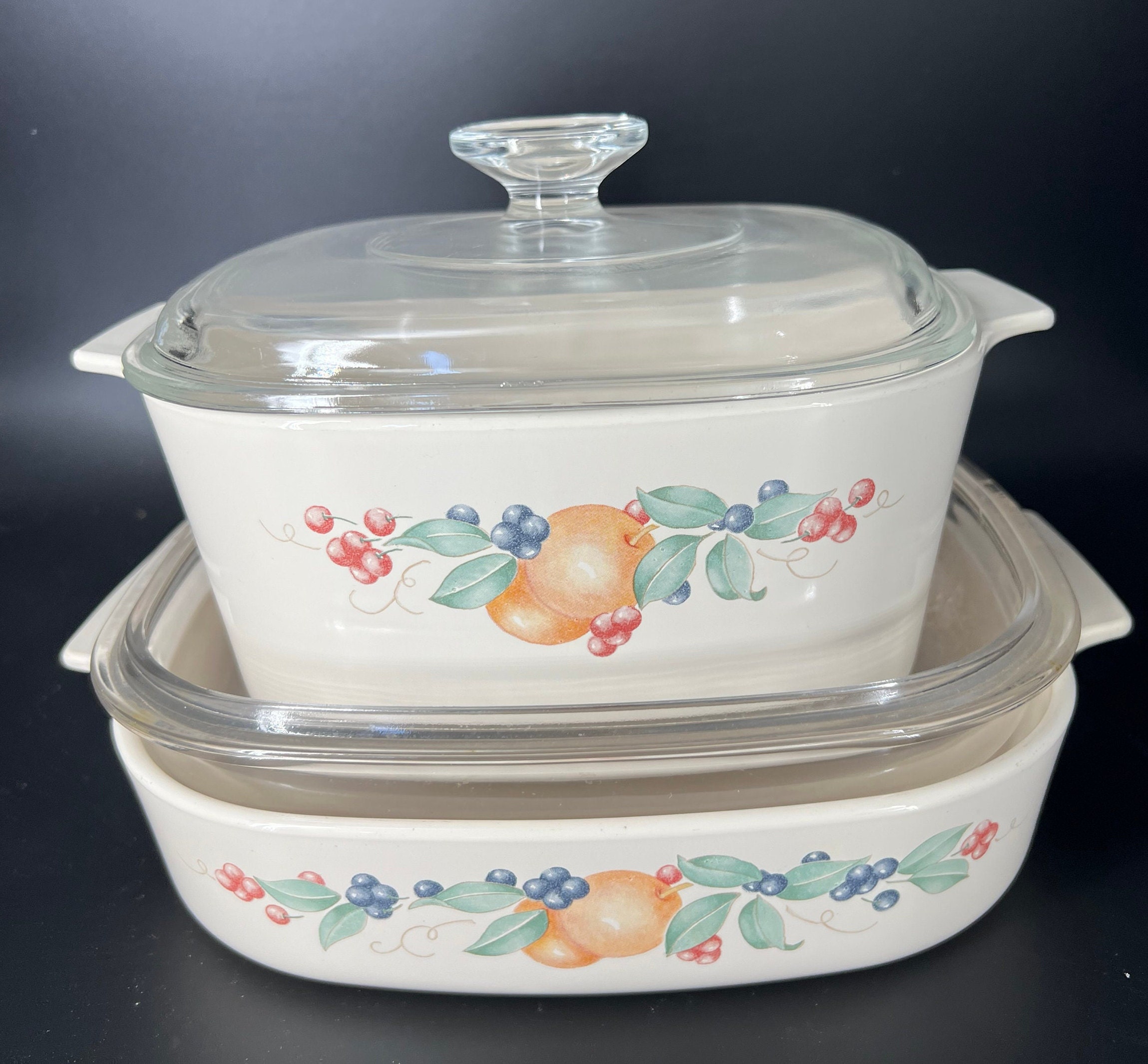
Abundance
A rich, detailed fruit and vegetable composition in warm earth tones — plums, grapes, squash, and more. Sold with Fireside (beige-tinted) lids until 1995, then clear lids. Pattern suffix -381.
Later Period
In stock · $45
1980s – 1990s
Autumn Meadow
A warm, earthy floral pattern featuring autumn-toned botanicals. One of the quieter 1980s patterns — less bold than the 70s roster, but pleasingly unpretentious. Typically found on saucepans and small casseroles.
In Stock
In stock · $25
1959 – 1963 (percolators only)
Black Starburst (Trefoil)
A bold black starburst / atomic age design used exclusively on percolators — never on casseroles or saucepans. Production ended in 1963; pieces were recalled in the late 1970s for a safety reason related to the handles. Surviving intact examples are genuinely rare. Typically fetches $80–150 when found.
RarePercolators Only
1958 – 1988 (revived)
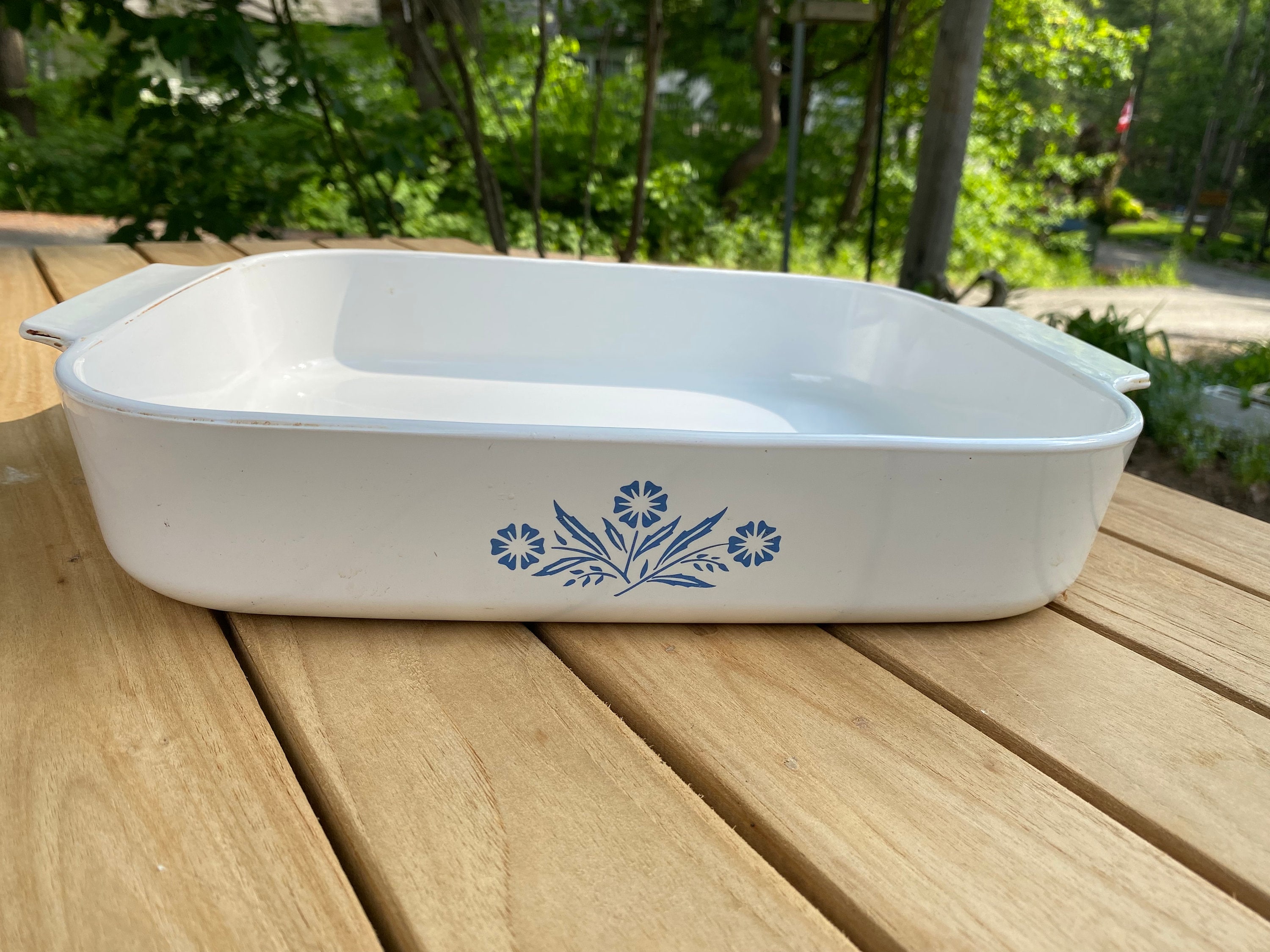
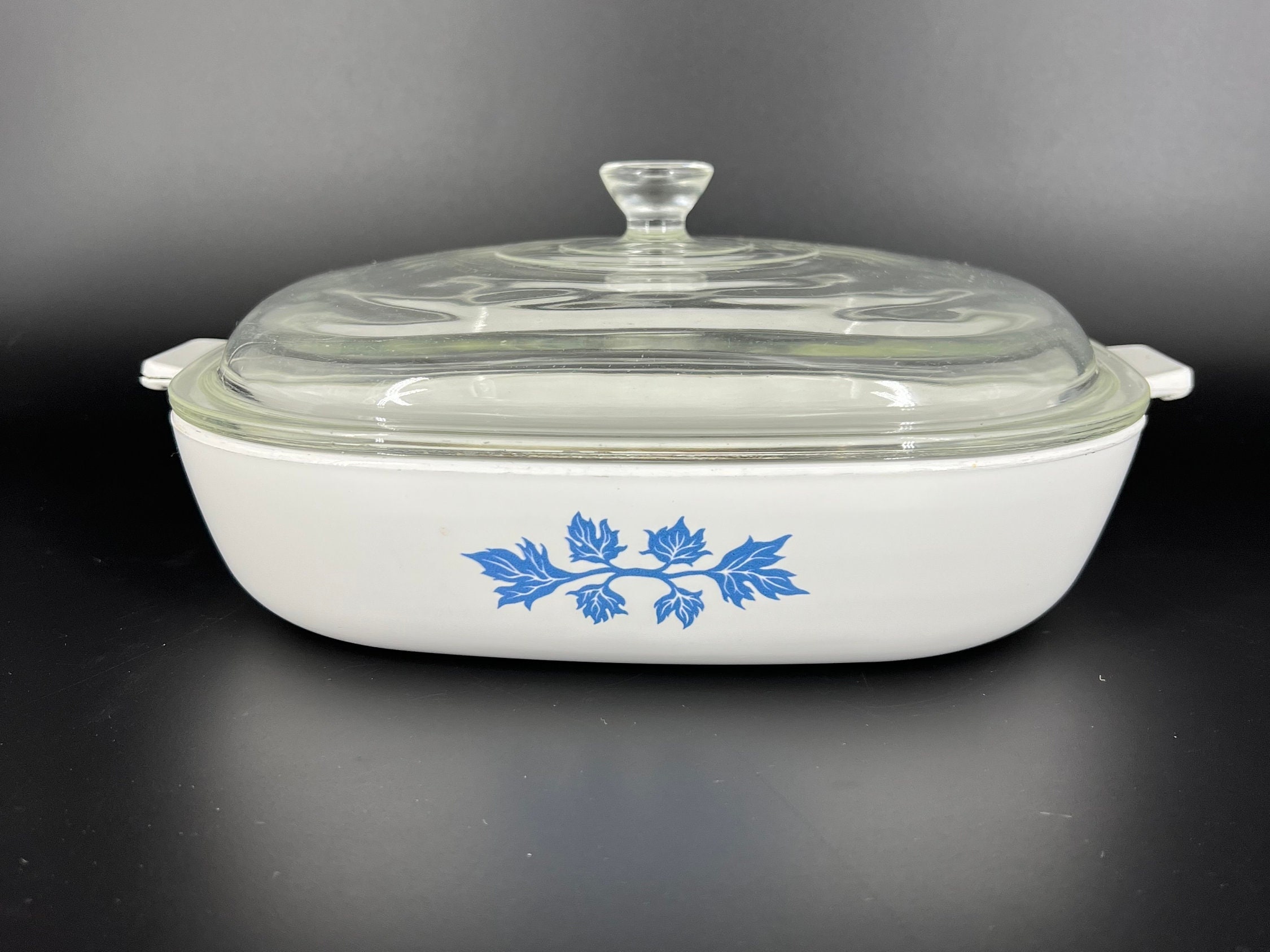
Blue Cornflower
The first and most produced CorningWare pattern. Three blue cornflowers on white. Designed by Joseph Baum. Pre-1972 pieces have sloped sides and small handles; post-1972 pieces have straight sides and larger handles. Still recognizable by anyone who has ever set foot in a North American grandmother's kitchen.
Most ProducedWidely Available
In stock · $34–$120
1980s – 1990s
Blue Dusk
A deep, moody blue floral pattern — more saturated than most of the soft pastels of its era. Relatively uncommon in the secondary market. A good option for collectors who want something with colour that isn't Cornflower.
In Stock
In stock · $42
1976 – 1977
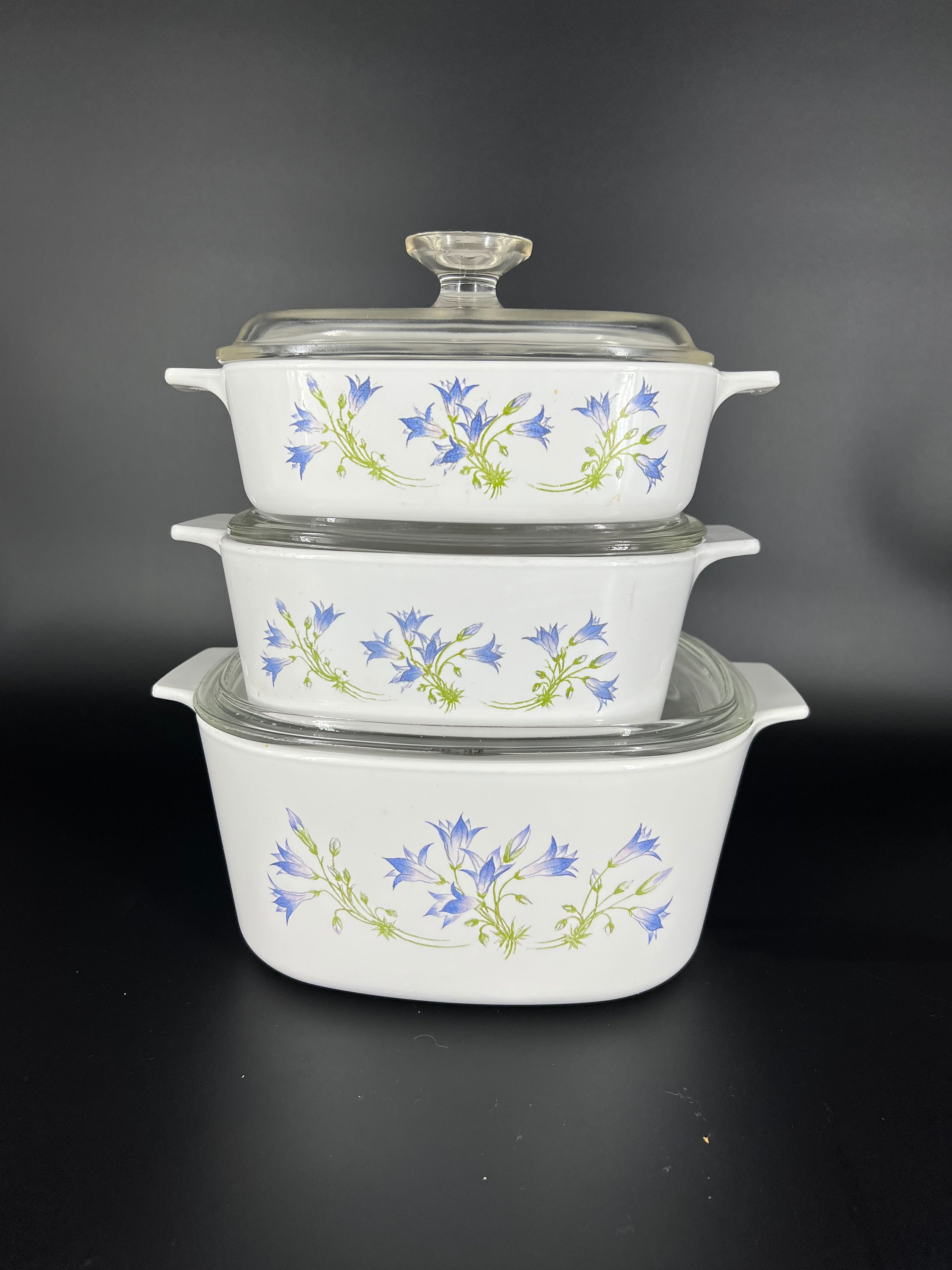
Blue Heather
A delicate, all-over sprig pattern in muted blue-purple tones. Produced for a very short window, which is what makes it collectible — not exceptional design, but genuine scarcity. One of those patterns that surfaces occasionally at estate sales and surprises even experienced collectors.
RareShort Run
1980s – 1990s
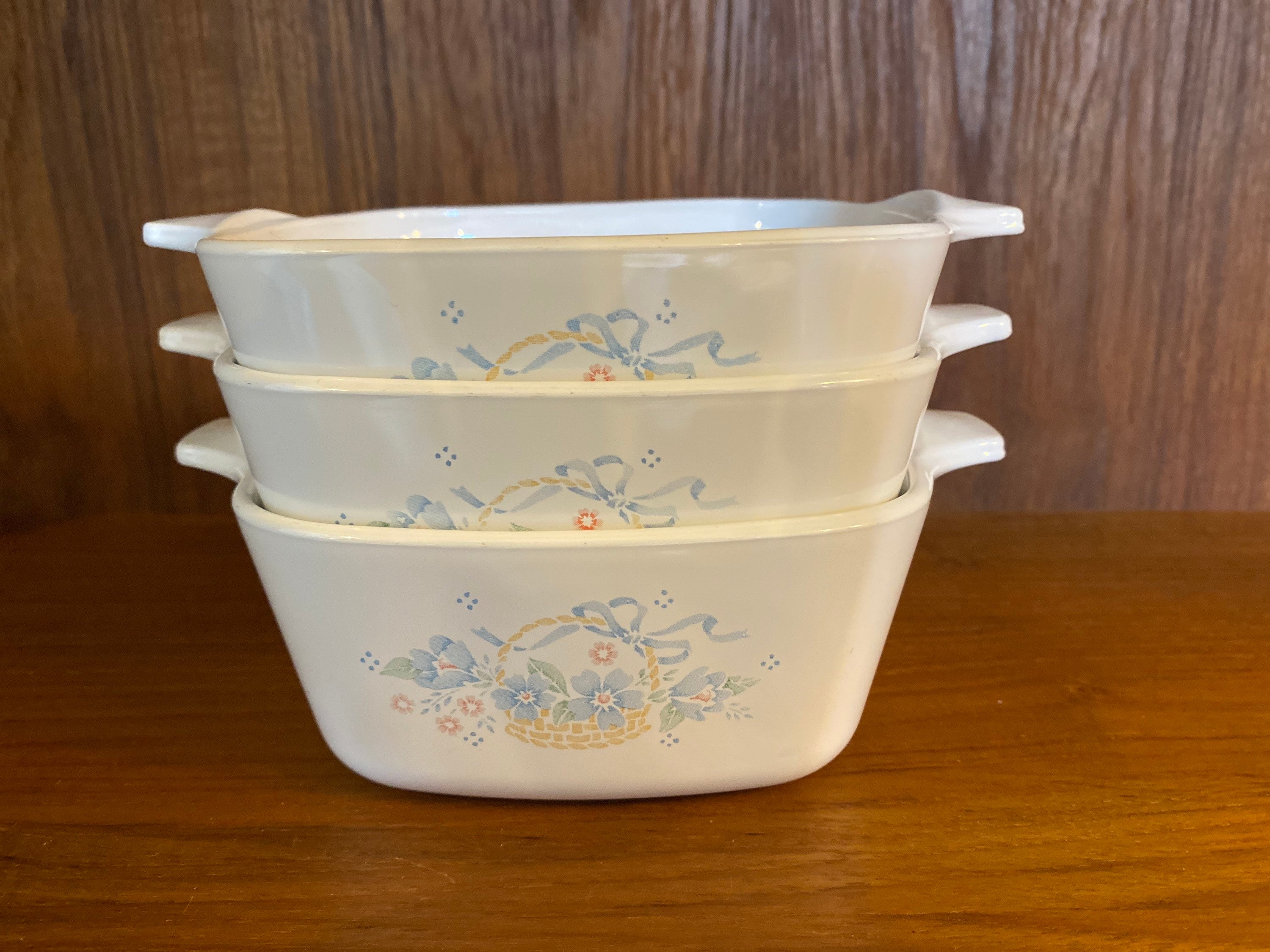
Blue Ribbon Flower Basket
A charming floral basket motif with blue ribbon detailing. Typically found on smaller casseroles and baking dishes. One of the more decorative patterns of the late era — the basket composition gives it a slightly more formal look than its contemporaries.
In Stock
In stock · $20–$50
1980s – 1990s
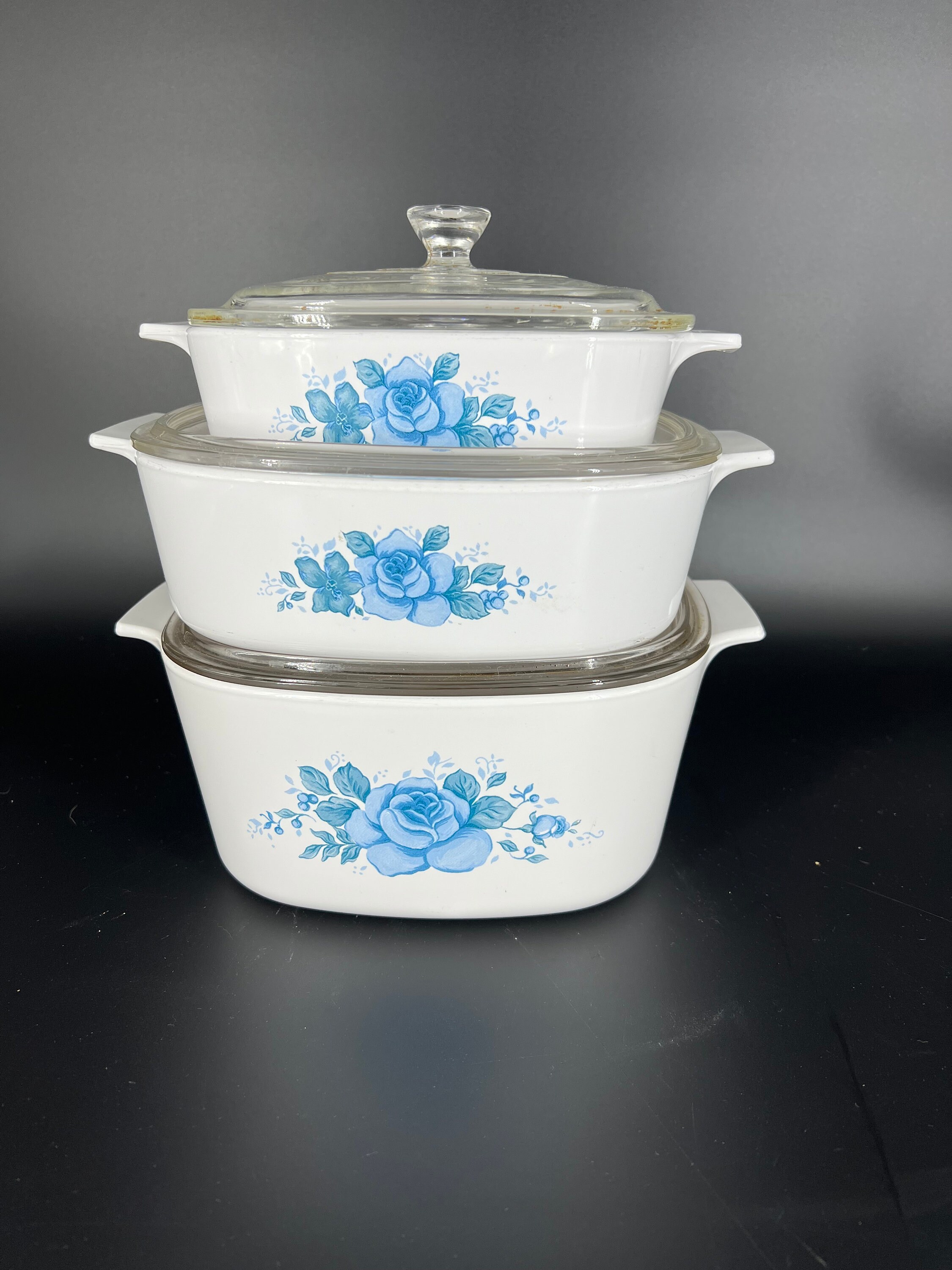
Blue Velvet Rose
Deep blue roses on white — a more dramatic take on the floral patterns of the period. The saturated blue palette distinguishes it from the softer pastels more common to this era. Relatively uncommon.
In Stock
In stock · $50
1969 only
Butterscotch
One of the round Buffet Server colours — a warm amber-yellow glaze with no printed pattern, produced for a single year. The yellow and Avocado (green) round pieces are the most sought-after of the solid-colour buffet servers. Not expensive, but legitimately hard to find.
One Year OnlyHard to Find
1980s – 1990s
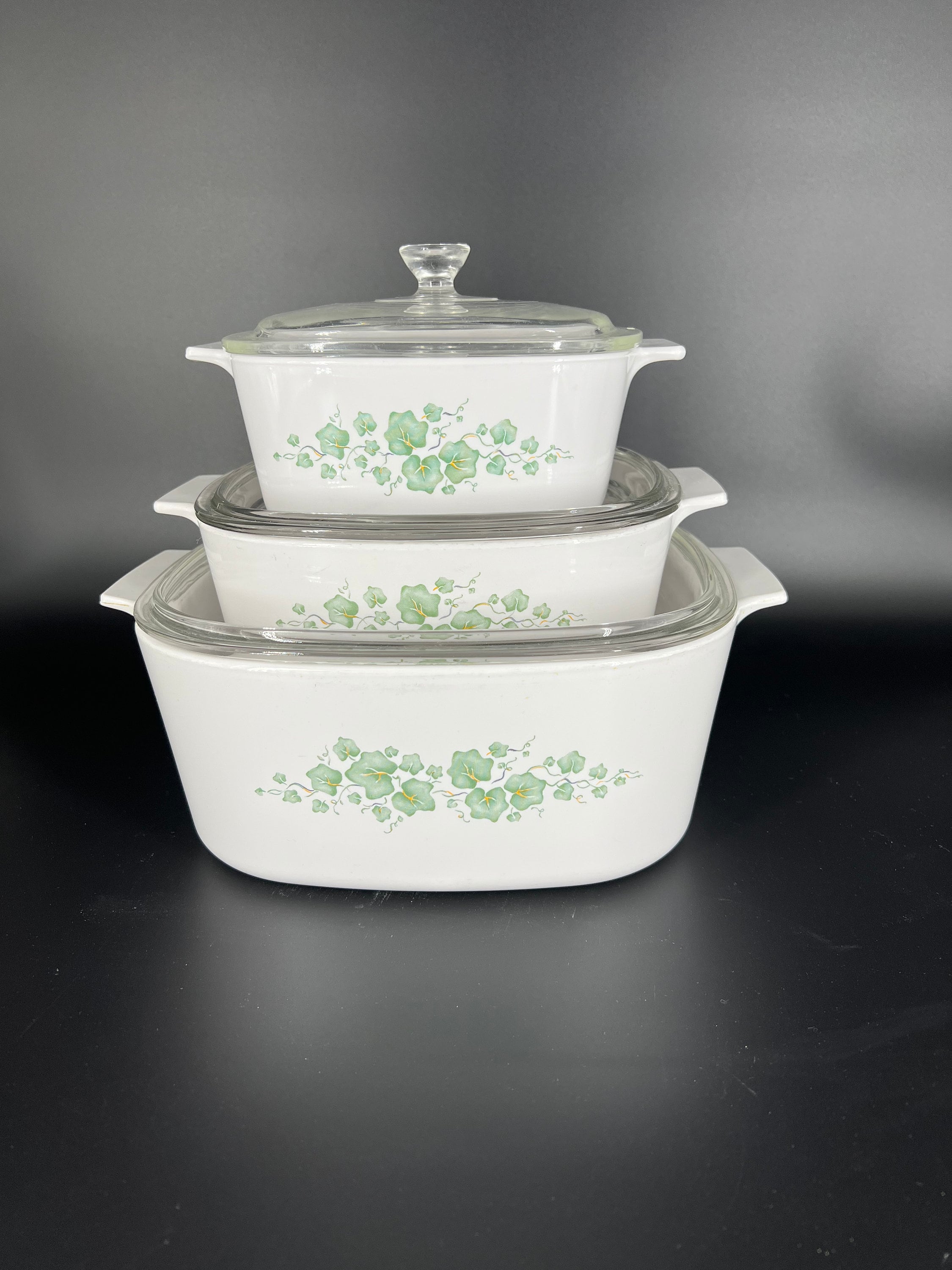
Callaway
A delicate vine-and-flower pattern in soft tones. Found on both casseroles and mugs — one of the few later patterns to appear across a wider range of forms. The mug version in particular surfaces with some regularity.
In Stock
In stock · $38–$44
1980s – 1990s
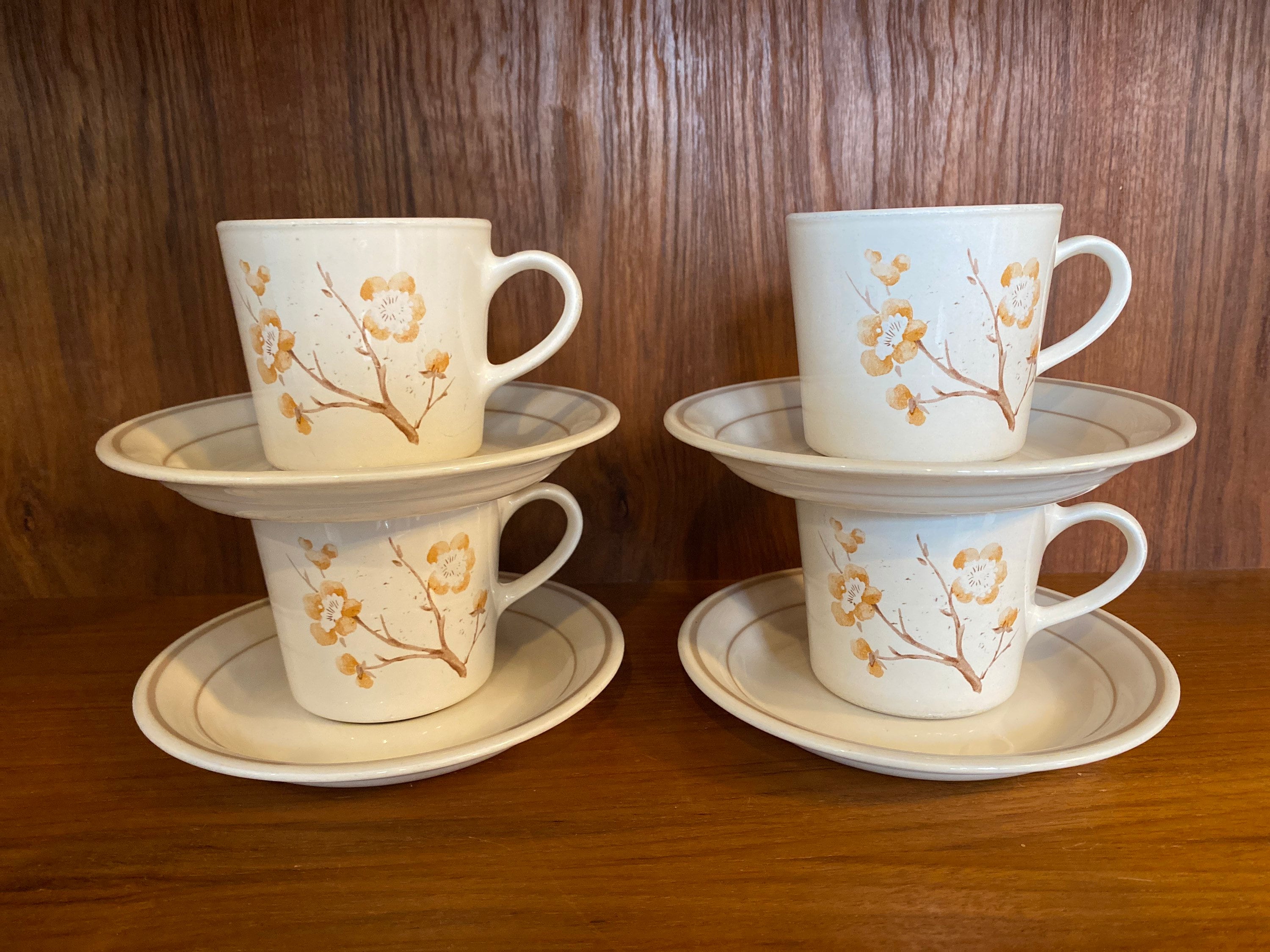
China Blossom
A fine-lined floral pattern with an East Asian-influenced aesthetic — delicate blossoms rendered in a restrained palette. Found on cups and saucers, which is relatively unusual for CorningWare.
In Stock
In stock · $40
1975 – c. 1984
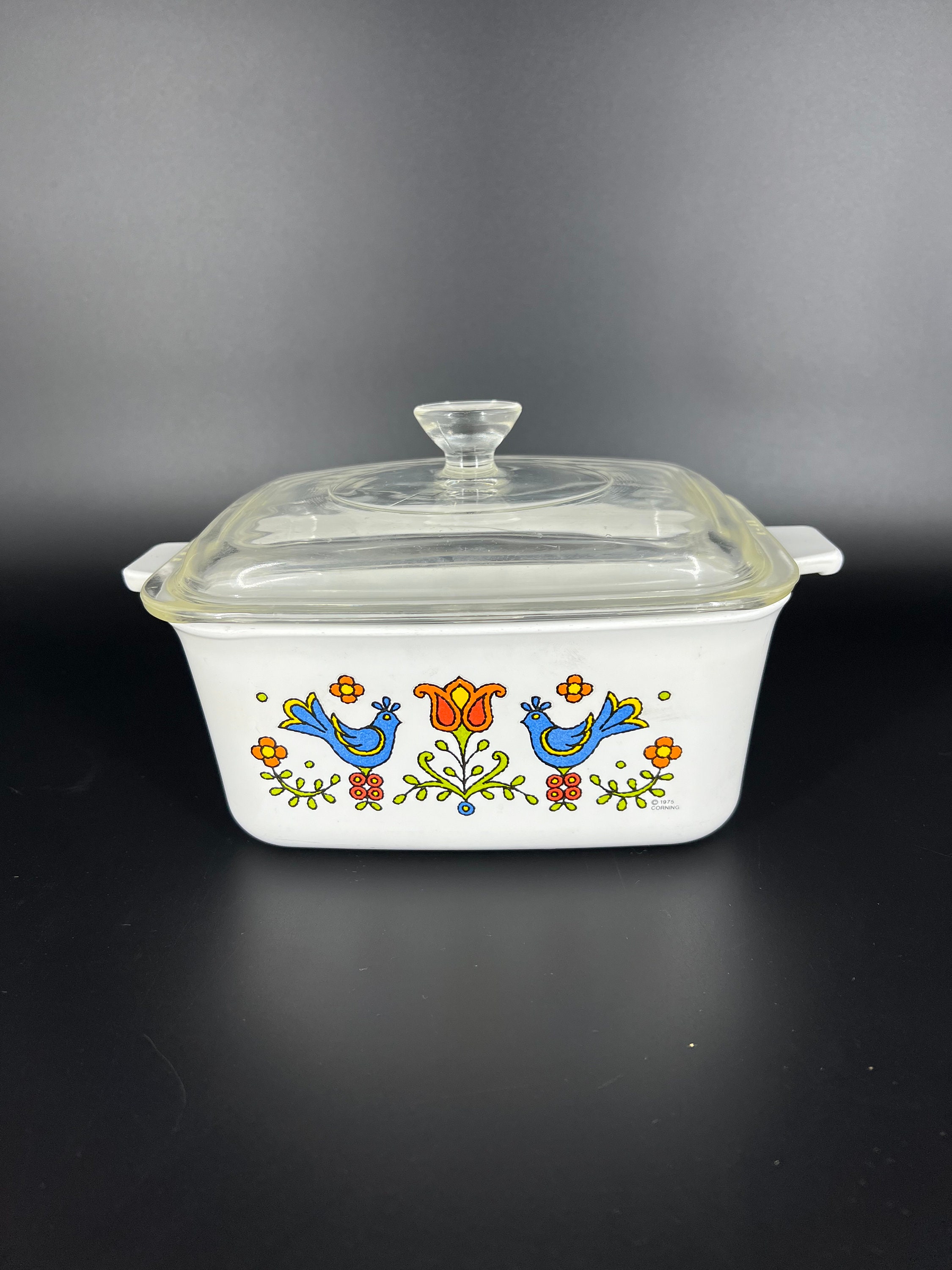
Country Festival
Also known as Friendship Blue Bird. Features a folk-art composition of blue birds, orange and yellow flowers, and green vines — a cheerful Scandinavian-inflected aesthetic that captured the mid-70s perfectly. One of the more visually distinct patterns in the lineup.
Collector Favourite
In stock · $70
1980s – 1990s
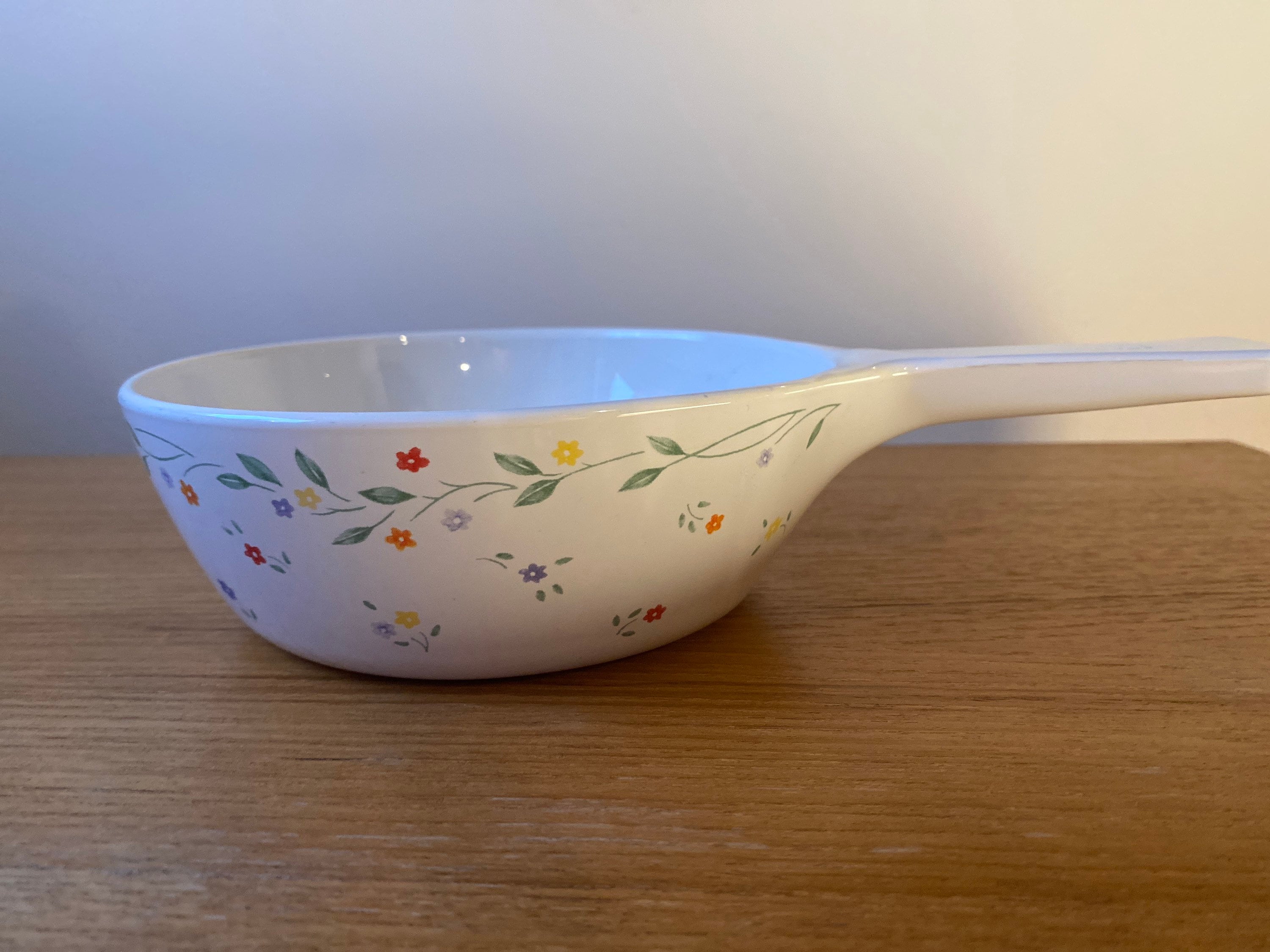
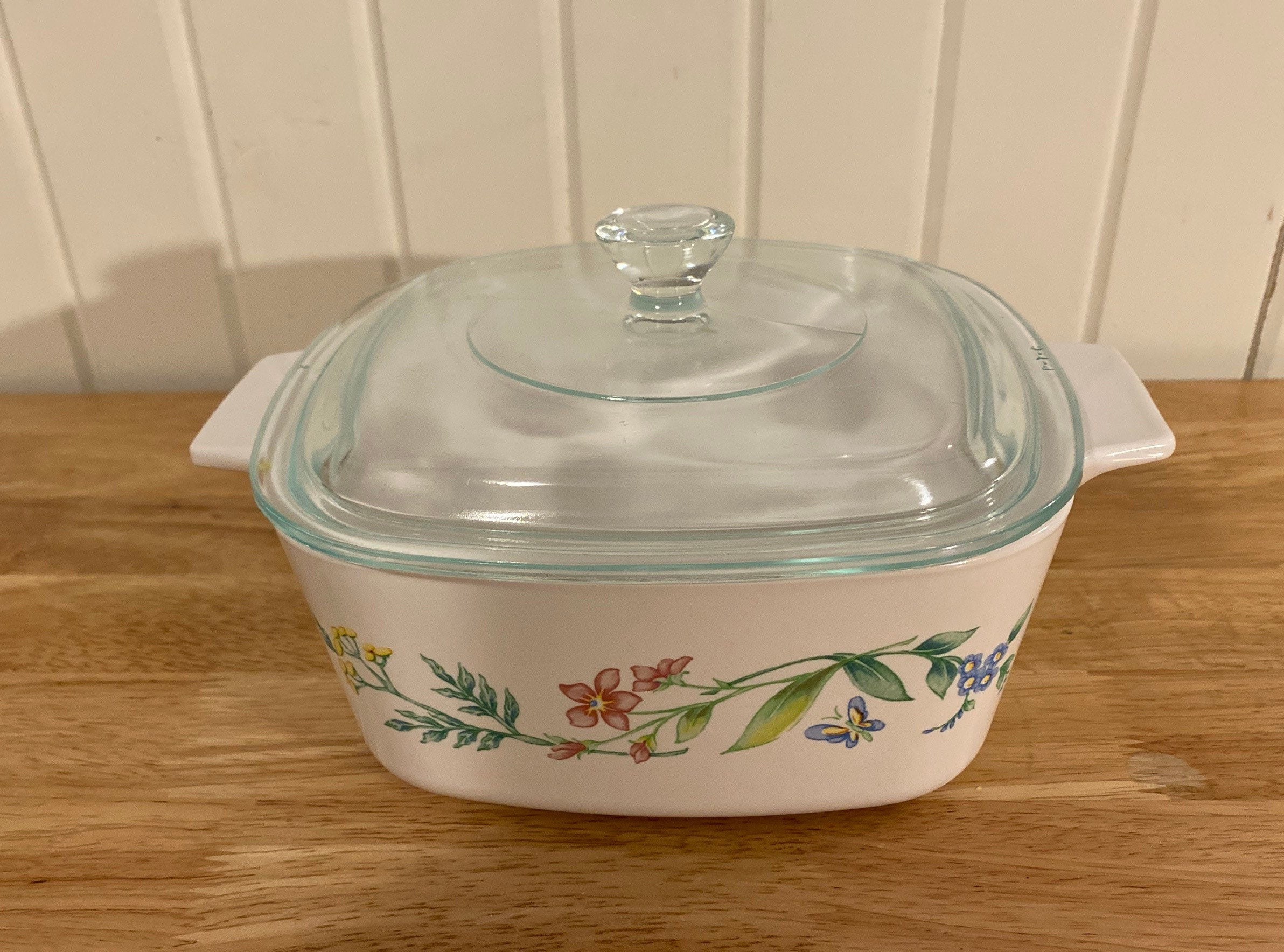
English Meadow
Small vines of delicate yellow, blue, and orange-red flowers. Captures the era's enthusiasm for all things British and cottage-garden. Multiple versions produced. Not particularly valuable — typically $10–20 at thrift — but plentiful and charming.
Common
In stock · $36
1970 – c. 1985
Floral Bouquet
A gift line that went mainstream. Colourful flowers in a tight, decorative cluster. Came in multiple editions; the 1969 original gift line (pattern suffix -500 series) is collectible. The second and third mainstream editions are common and affordable.
Gift Line Origin
1978 – present
French White
No pattern — just clean white Pyroceram. The F-series shape is slightly different from the A-series (notably the roaster). Introduced in 1978 and relaunched in 1997 as solid white without the original oval shape. Still in production today. A modernist's CorningWare.
Still in Production
1980s – 1990s
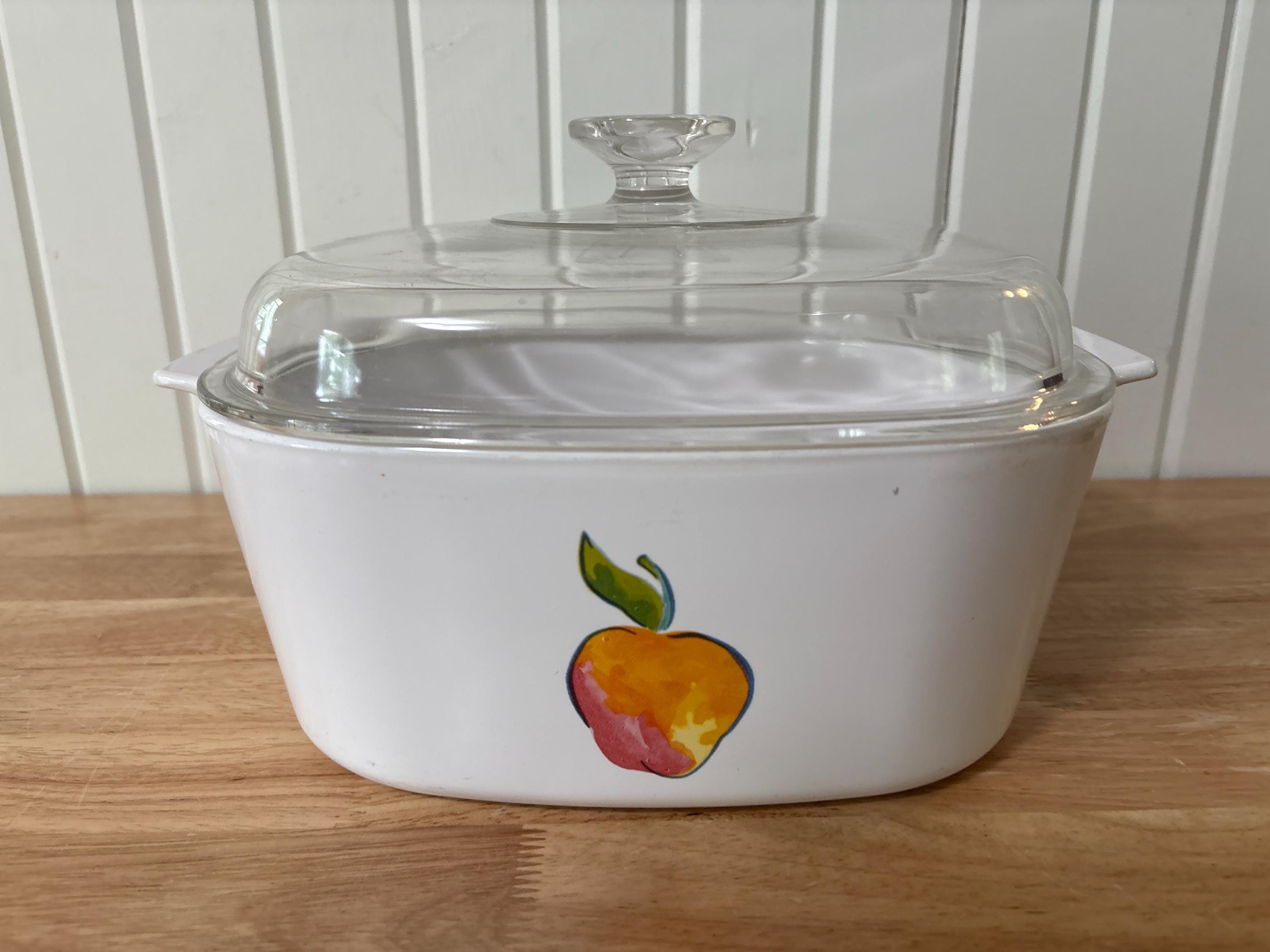
Fruit Basket
A warm, illustrative fruit composition — apples, pears, and cherries in a basket. Found across casseroles and mugs. The mug version is particularly common and makes a good entry point for new collectors.
In Stock
In stock · $36–$120
1972 – c. 1978
L'Échalote (Spice O' Life — French)
The early French-inscribed version of Spice O' Life, with herb names rendered in French (L'Échalote = shallot, Marjolaine = marjoram, etc.). Produced on the Menuette pan and smaller pieces. Commands notably higher prices than the later English-only versions and is the one to look for.
Higher ValueEarly Edition
In stock · $24
1990s
Leaves Blowin' in the Wind
A loose, painterly leaf pattern in warm autumn tones — one of the more expressive designs from CorningWare's later period. Found on skillets, which is an unusual form. The 10" skillet with lid is a functional and visually distinctive piece.
Later Period
In stock · $100
1972 – 1974 (promotional only)
Medallion
A promotional pattern produced exclusively for Shell Oil Corporation and distributed through Shell service stations — never sold in retail stores. The small production run and non-retail distribution make it one of the more interesting pieces to track down. Values range from $30–100 depending on condition and piece type.
Promotional OnlyNon-Retail
c. 1975 – 1981
Merry Mushroom
Bold, cartoonish mushrooms in red-orange and brown — a Sears exclusive for the round Buffet Server shape. Very much a product of the 70s, and beloved for exactly that reason. Not found on the square A-series pieces. A favourite among collectors who embrace the era's maximalist kitchen aesthetic.
Sears ExclusiveRound Only
1980s – 1990s
My Garden
A soft garden-style floral, typically found on smaller casseroles. The name is evocative of the broader cottage-garden aesthetic that ran through much of CorningWare's 1980s catalogue. A solid mid-market piece.
In Stock
In stock · $45
1971 only
Nature's Bounty
A harvest-themed gift line with vegetables rendered in a warm mustard yellow. Divisive — people either love the earthy palette or find it drab. That ambivalence keeps prices moderate despite genuine rarity. Model suffix -71.
Gift LineOne Year
1985 – mid-1990s
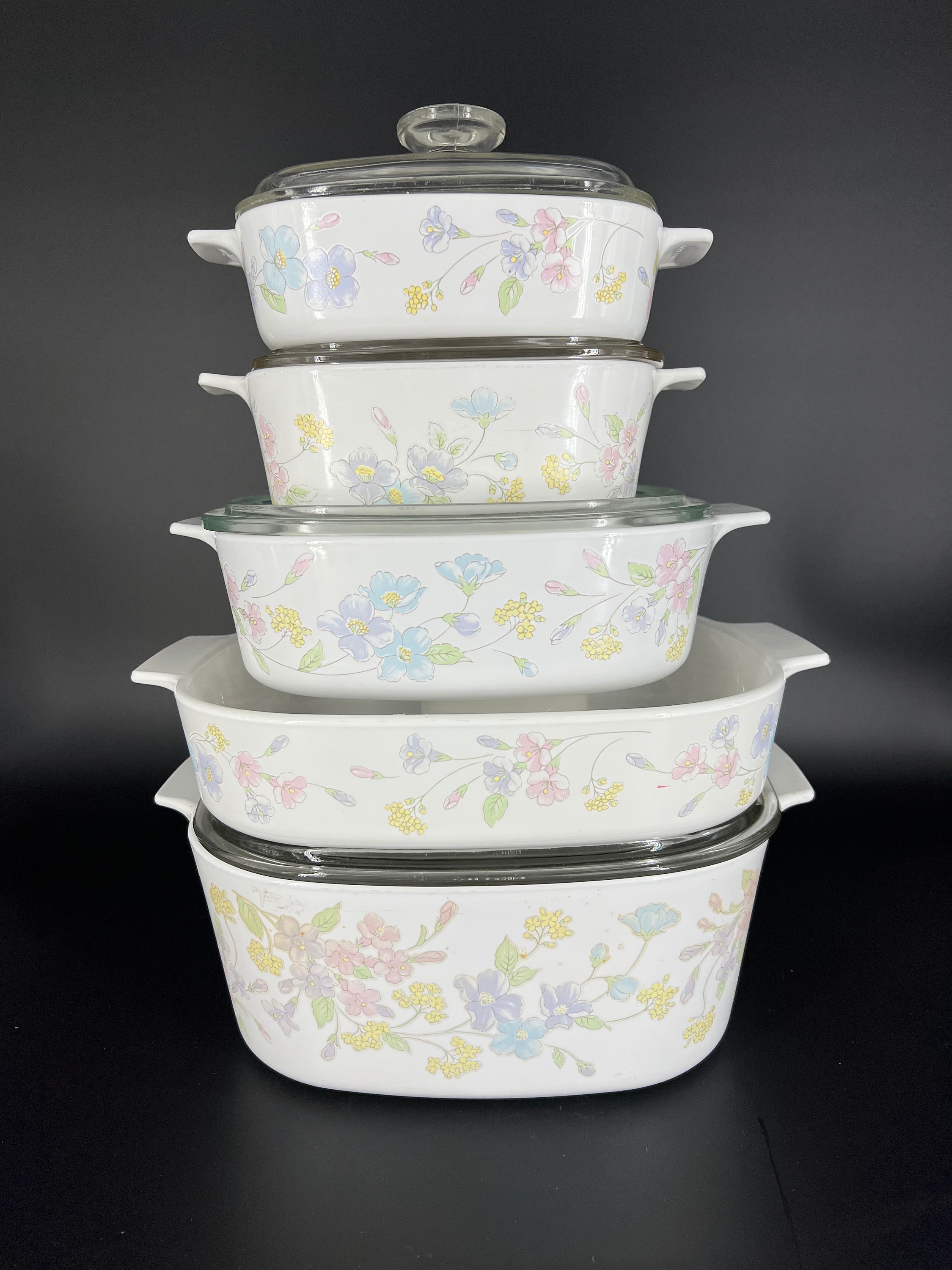
Pastel Bouquet
Soft, watercolour-style pastel flowers — pinks, lavenders, yellows. A gentler aesthetic than the bold 70s patterns. Popular with collectors who remember it from their mothers' kitchens in the Reagan era.
Recognizable
In stock · $24
1980s – 1990s
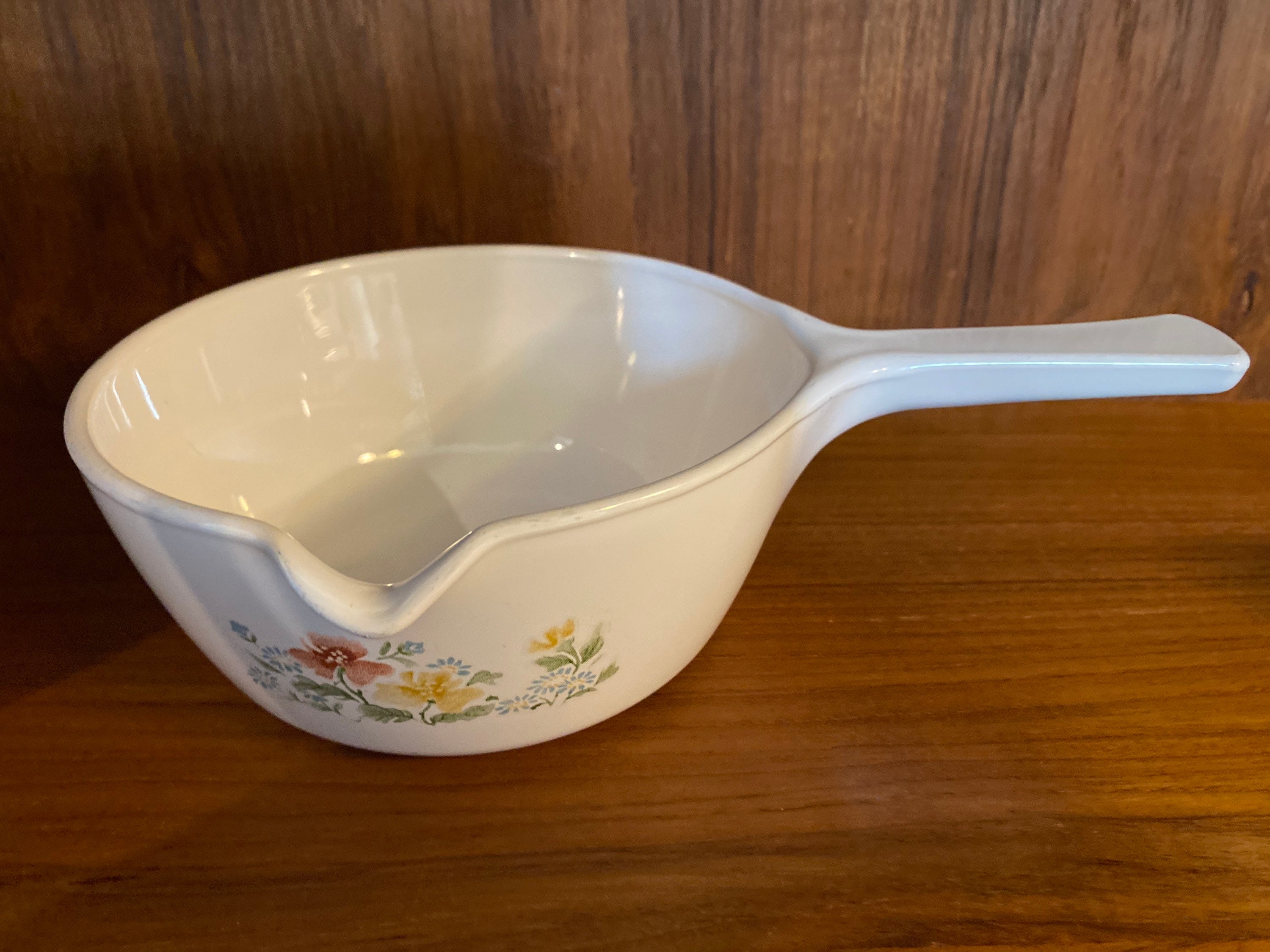
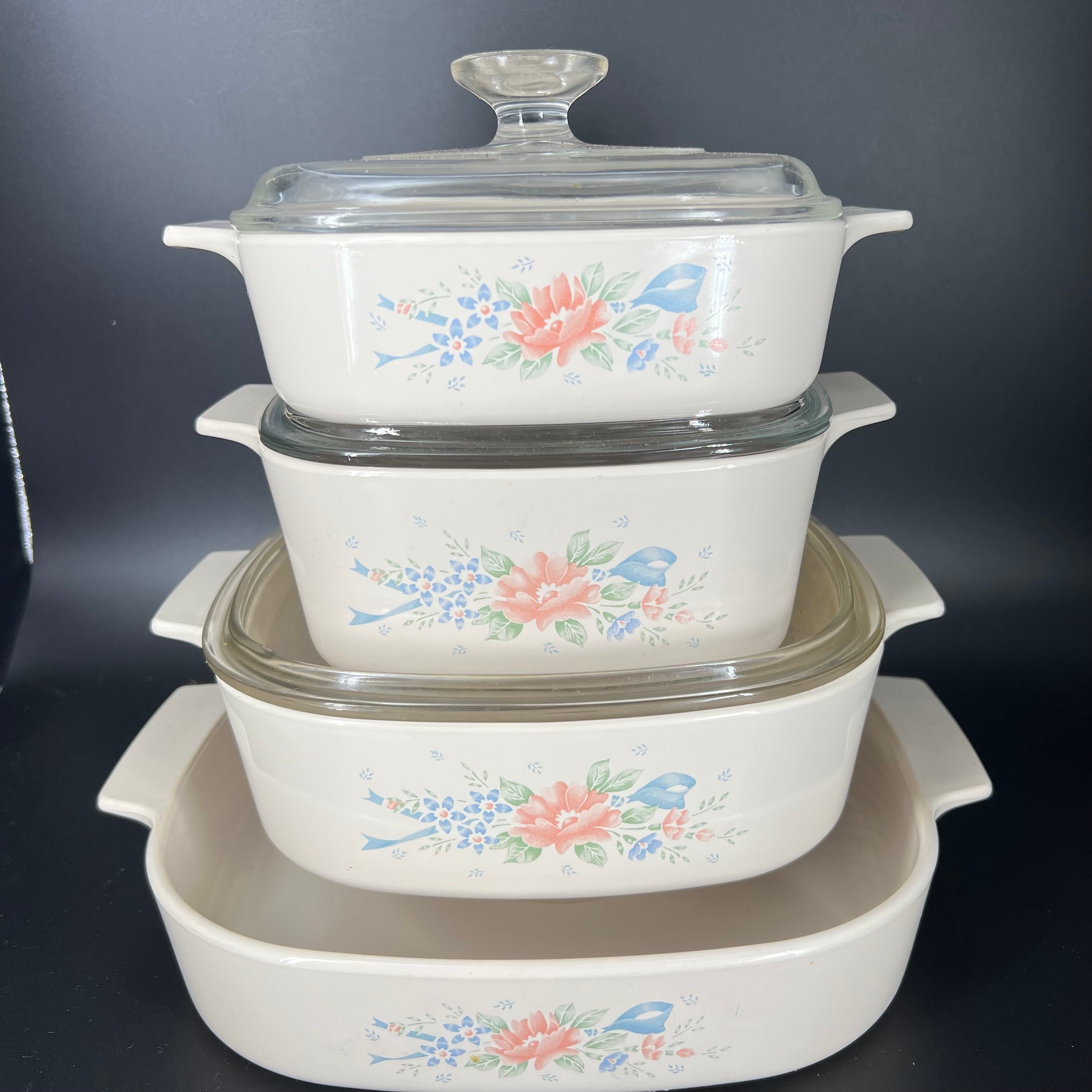
Peach Floral
A warm peach-toned floral pattern — one of the more complete patterns in the late catalogue, found across casseroles, mugs, bowls, and serving pieces. The creamer and sugar set is a standout. The breadth of available pieces makes it appealing for collectors who want a functional set.
In Stock
In stock · $39–$60
1966 – 1968
Platinum Filigree
A limited gift line with a delicate platinum-coloured filigree overlay — elegant, restrained, and very much of its mid-60s moment. Only five pieces were ever produced in this pattern. Rare enough that finding a complete set is a genuine accomplishment.
Gift Line5 Pieces Only
1959 – 1973 (percolators only)
Platinum Starburst
Silver-toned atomic starburst, also confined to percolators. A slightly more elegant take on the same mid-century motif. Rarer than the black version simply because fewer survive. Collectors with strong mid-century modern sensibilities prize these.
RarePercolators Only
1970 only
Renaissance
A limited gift line from 1970, featuring an ornate gold-toned floral motif — arguably the most sophisticated-looking pattern Corning ever produced. Genuinely rare, genuinely beautiful, and one of the better investment pieces for serious collectors. Model suffix -70.
Gift LineOne Year
1970s – 1980s
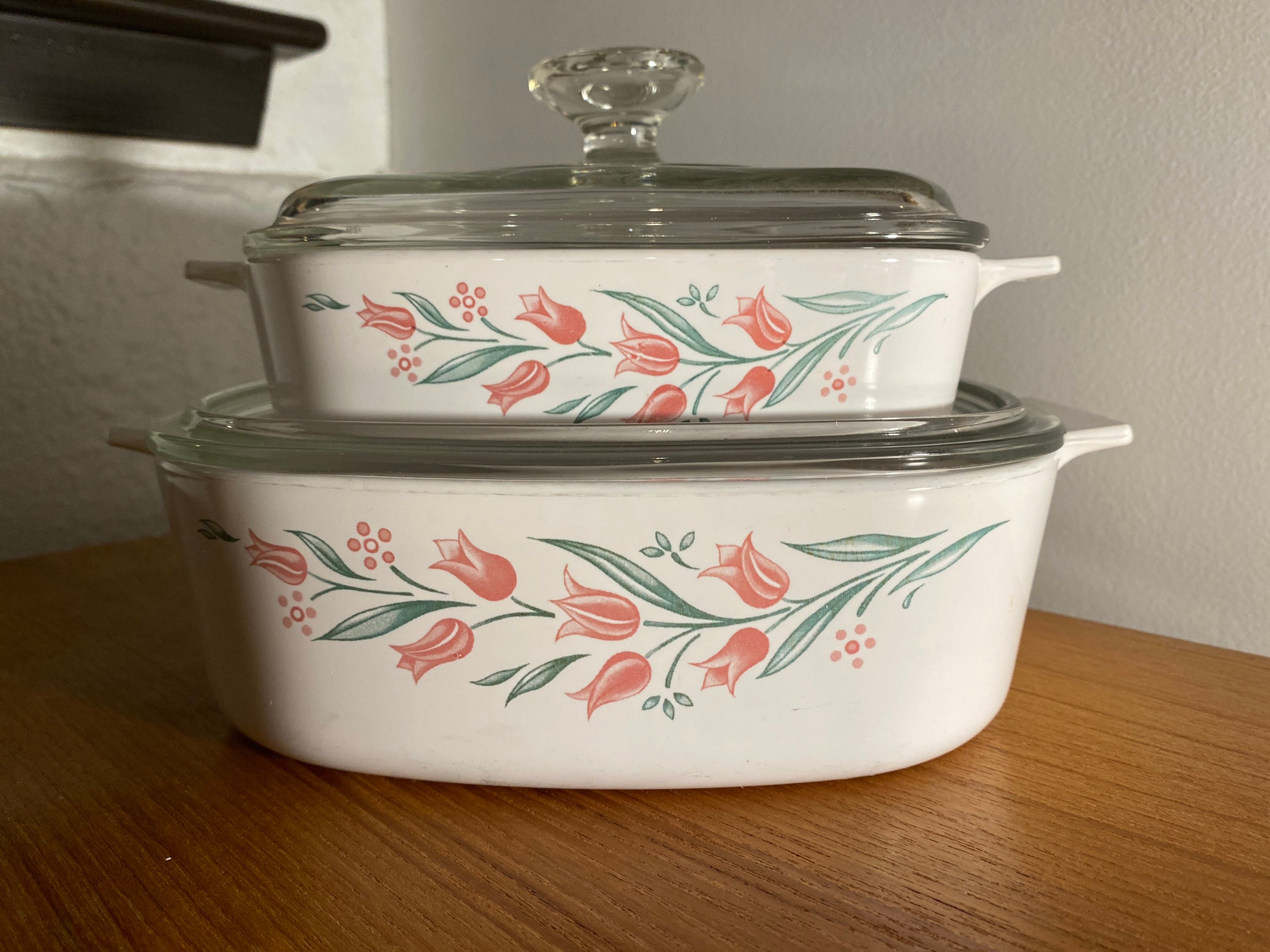
Rosemarie
Pink tulips on white — a cheerful, feminine pattern that sits somewhere between the bold 70s florals and the softer 80s aesthetic. Found on both baking dishes and casseroles. The pink tulip motif is distinct enough to identify quickly in a thrift store.
In Stock
In stock · $40–$80
1985 – mid-1990s
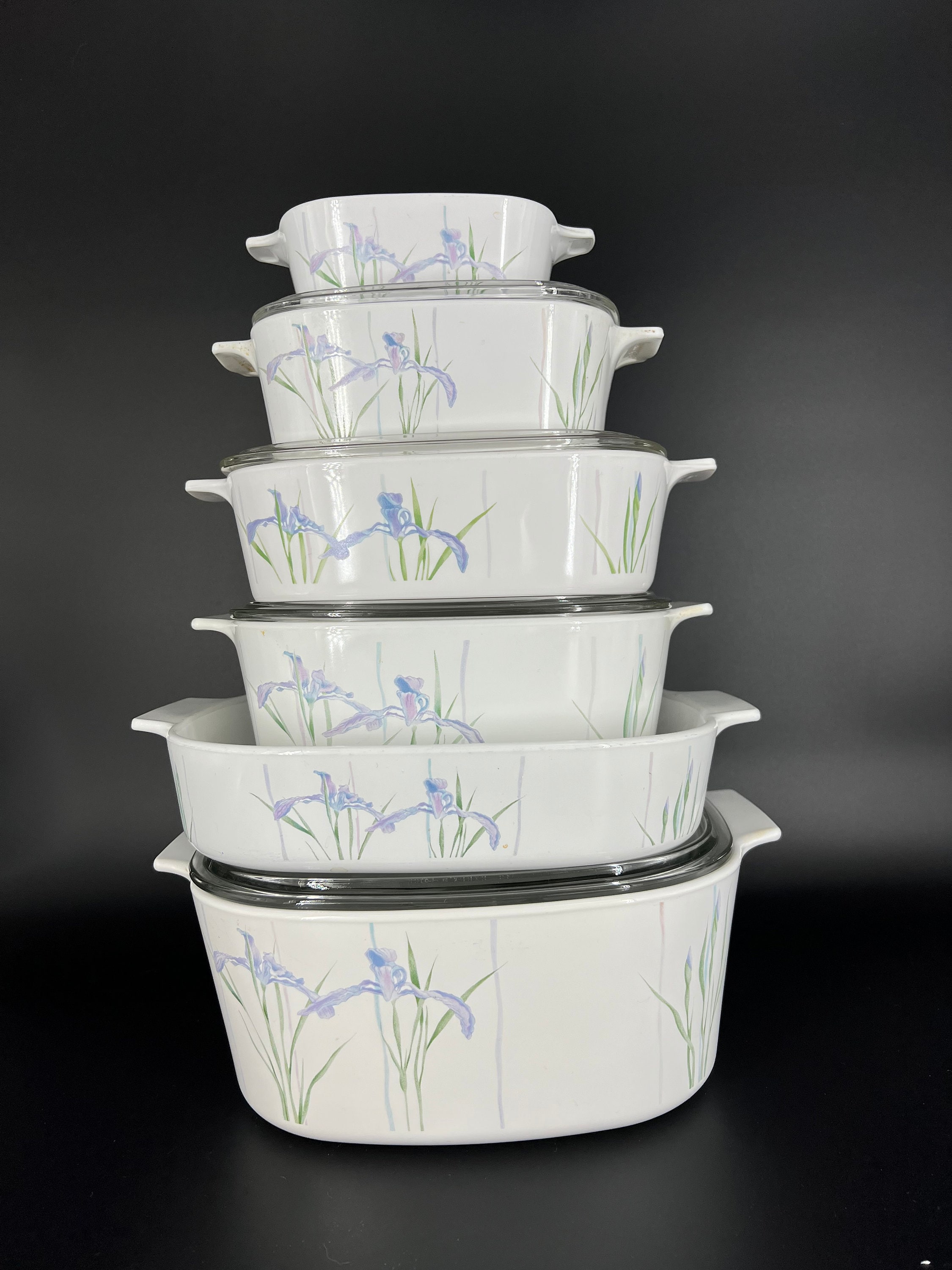
Shadow Iris
Delicate purple irises in a restrained, elegant composition. One of the more sophisticated-looking 1980s patterns. Often found in excellent condition as it skewed toward more careful owners. Model number suffix -333.
Mid-Market
In stock · $30
1980s – 1990s
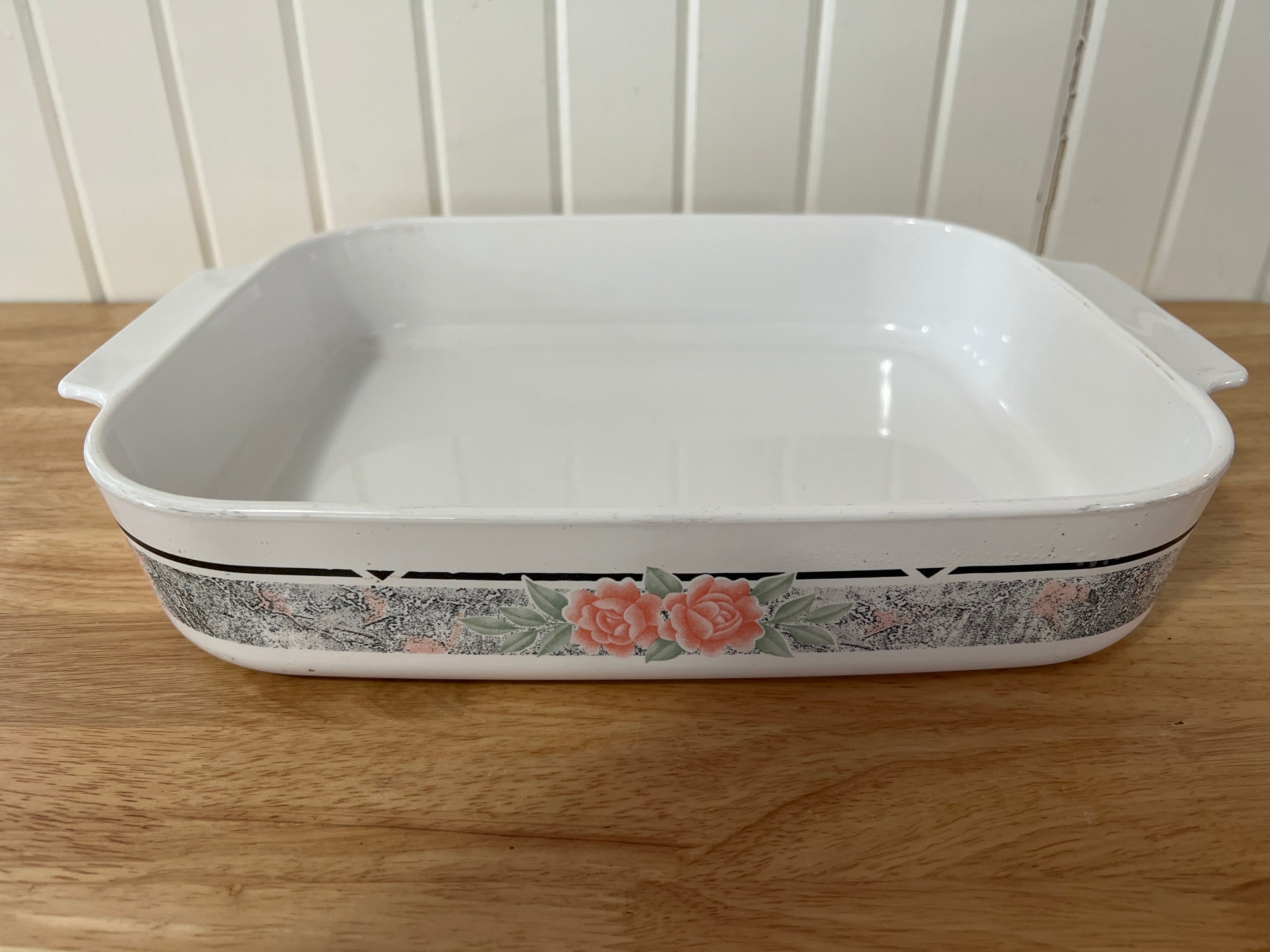
Silk and Roses
A soft rose pattern with a slightly silkier, more painterly quality than most CorningWare florals. Found on both lasagna pans and casseroles. The A-21-B lasagna pan version is a good practical piece.
In Stock
In stock · $40–$60
1972 – 1987
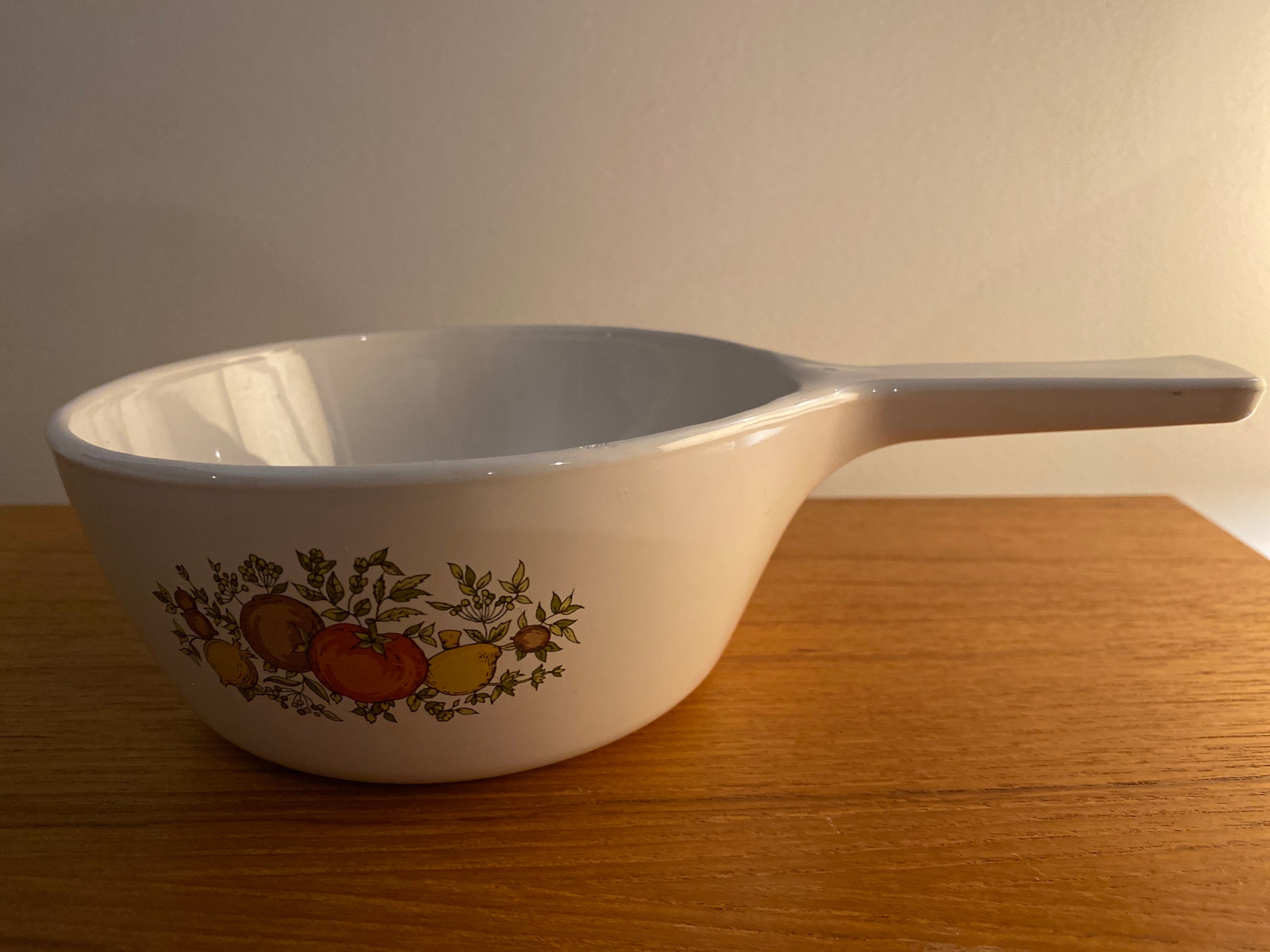
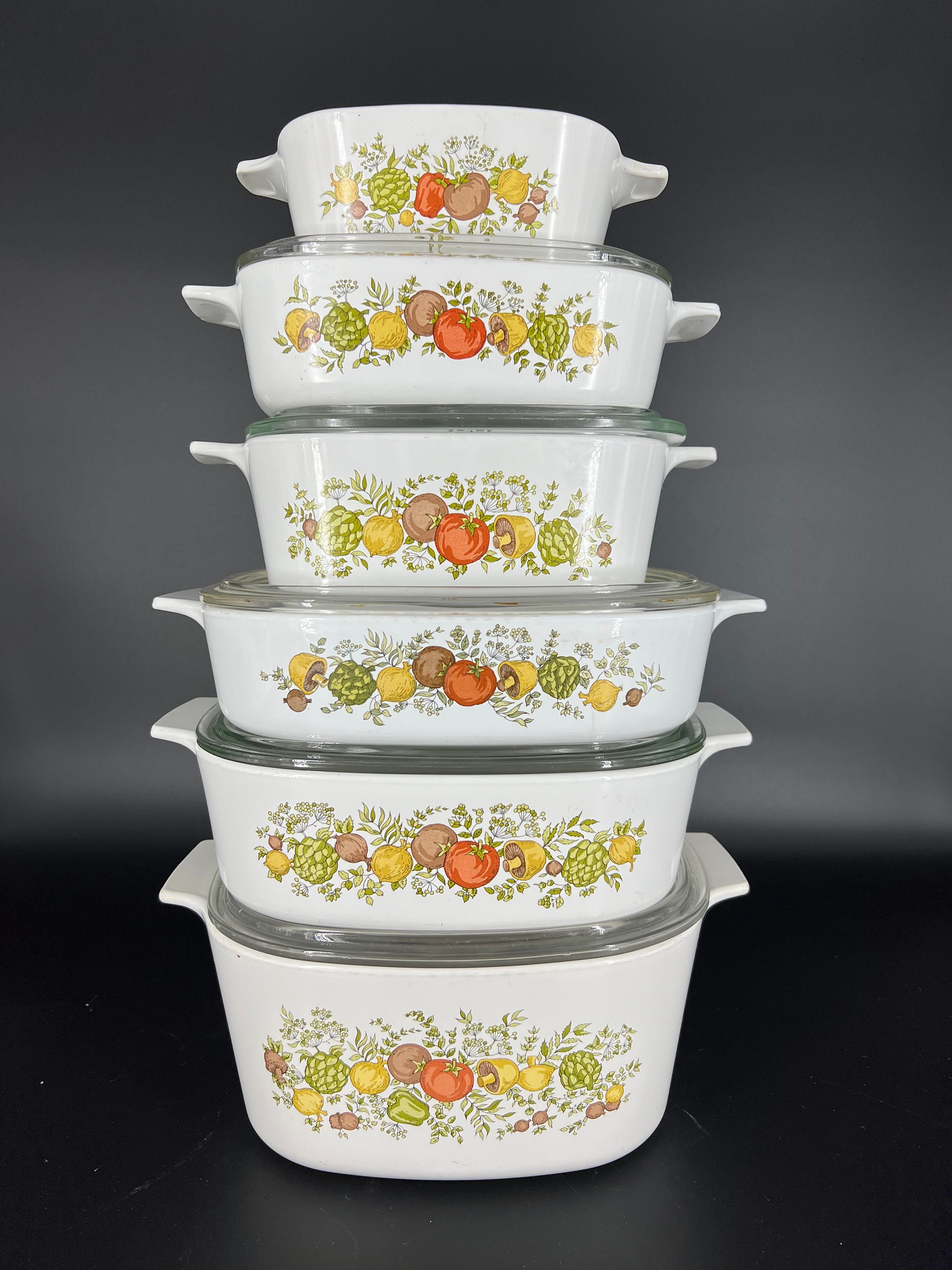
Spice O' Life
Vegetables and herbs — mushrooms, garlic, green peppers, artichokes, tomatoes — rendered in a loose illustrative style. Originally carried French inscriptions (L'Échalote, Marjolaine, etc.) on early pieces; later editions dropped this. The French-inscribed version commands notably higher prices. The second-most-produced pattern, and arguably the most recognized after Cornflower.
Second Most Produced
In stock · $24–$52
1980s – 1990s
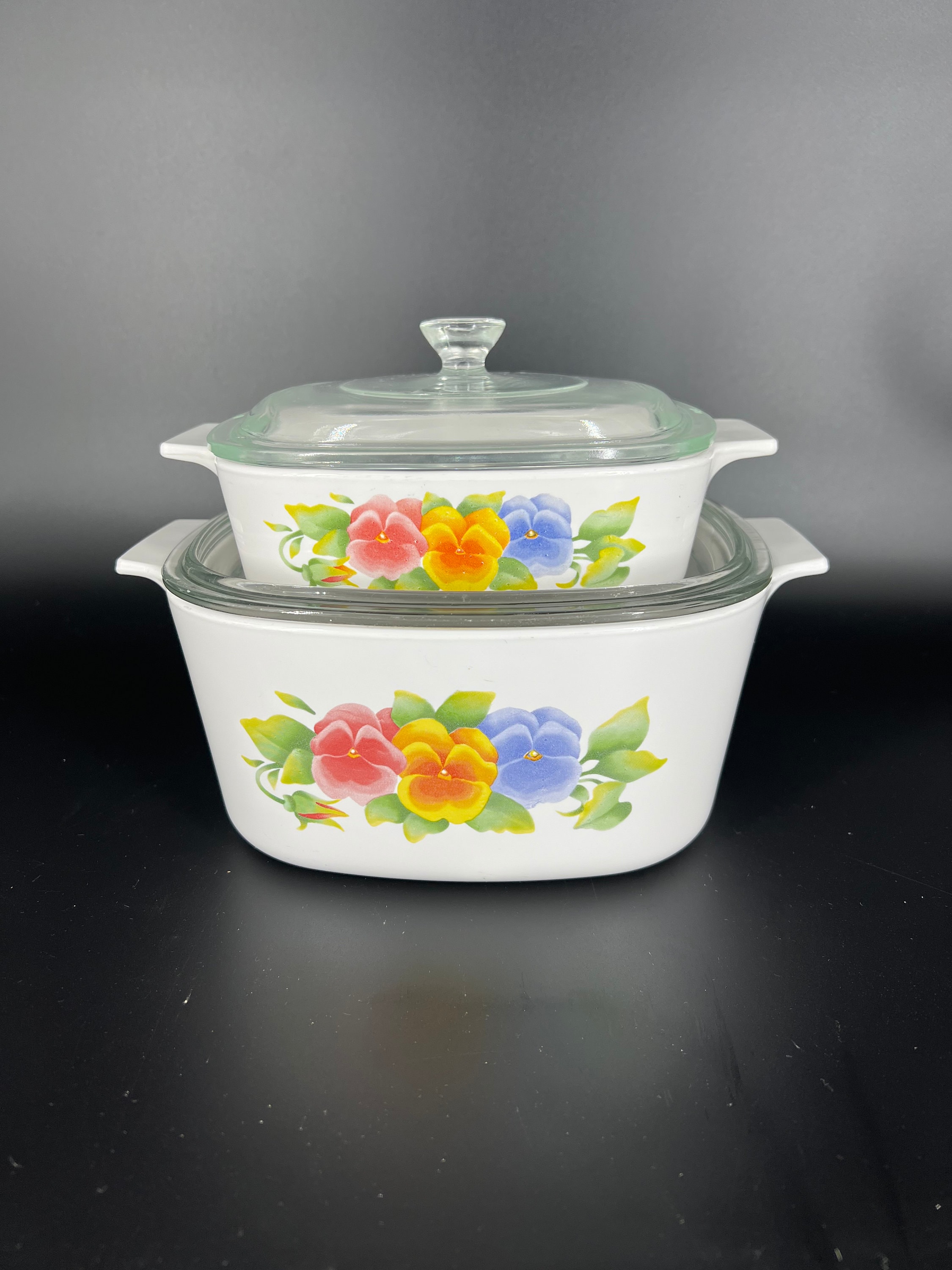
Summer Blush
A warm pink floral with a summery, open composition. Sits comfortably in the soft-pastel 1980s range. Good condition examples are easy to find — the pattern was produced in quantity and saw careful use.
In Stock
In stock · $35
1990s
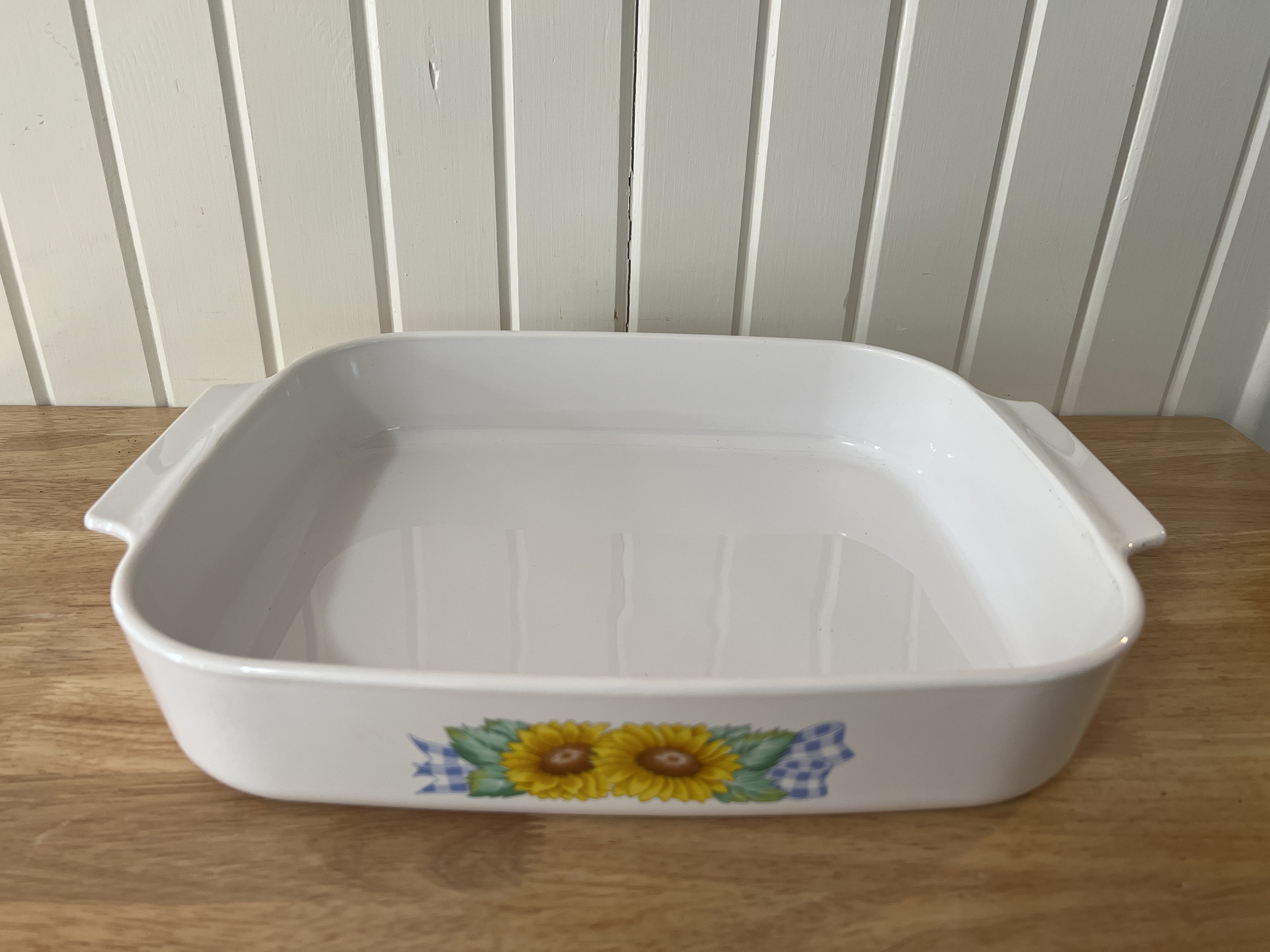
Sunsations
A bold sunflower pattern from the later CorningWare catalogue — the sunflower motif was everywhere in 1990s home décor, and this piece is very much of its moment. Found on the A-21-B lasagna pan. Condition tends to be excellent given its relative youth.
Later Period
In stock · $100
1980s – 1990s
Symphony
A restrained, elegant floral — small blossoms in muted tones, more classical in feel than most of the CorningWare pattern range. Found on casseroles. A good choice for collectors who want something understated.
In Stock
In stock · $30
1983 – late 1990s
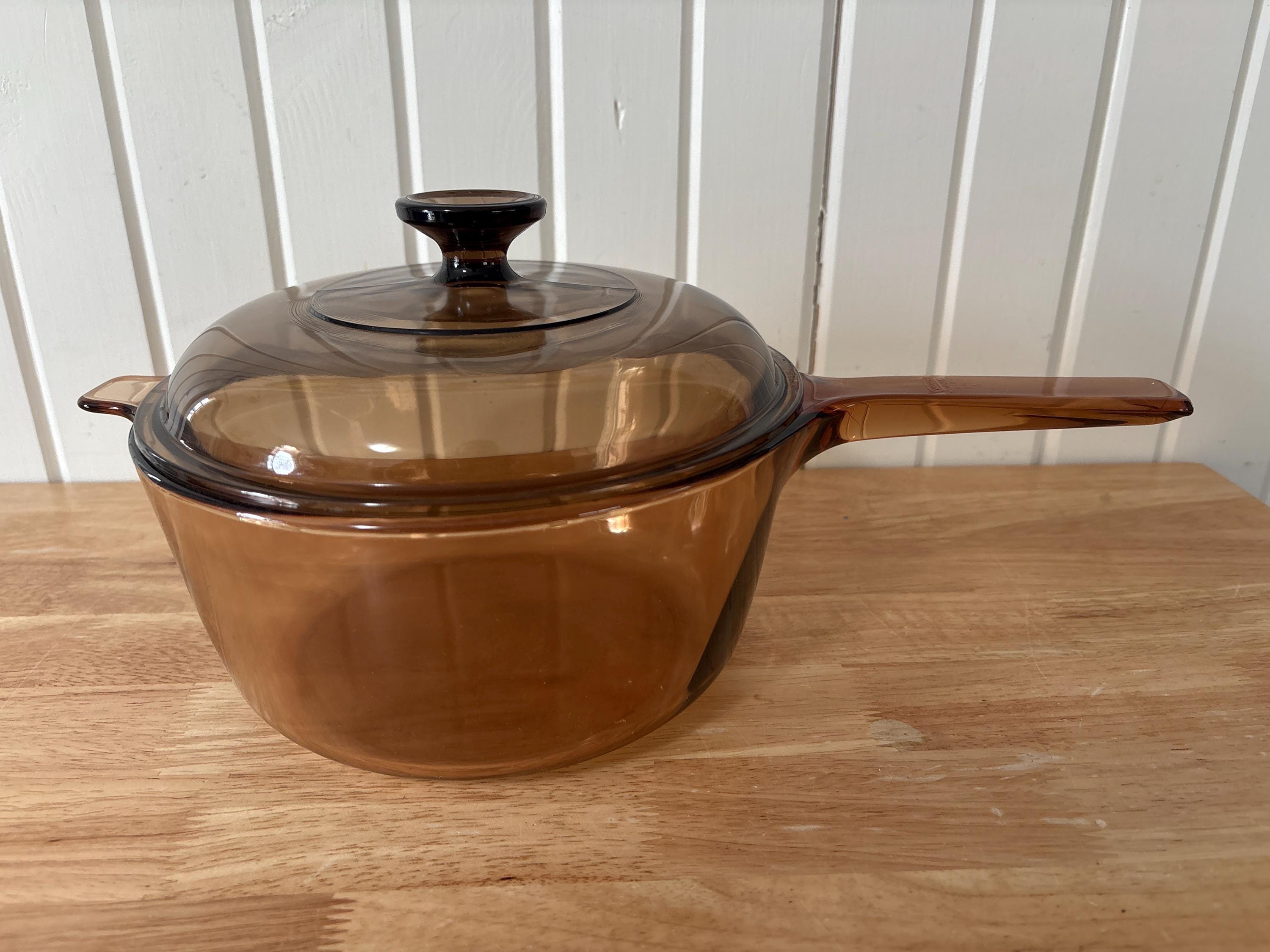
Visionware (Amber)
Corning's amber-tinted glass-ceramic cookware line — technically Visions, not CorningWare, but closely related and often collected alongside it. The amber colour comes from the glass-ceramic composition itself, not a glaze. Stovetop-safe, oven-safe, and visually distinctive. The casserettes and pots are the most common forms.
In Stock
In stock · $25–$65
1958 – 1959 (test market only)
Wheat
The very first CorningWare pattern — a wheat stalk motif that test-marketed poorly and was quickly replaced by Blue Cornflower. The golden version was used 1958–1959. Green Wheat and Golden Wheat were also produced in later limited runs. Pre-market Wheat pieces are among the rarest CorningWare objects in existence.
Extremely RareShort Run
1977 – 1984
Wildflower
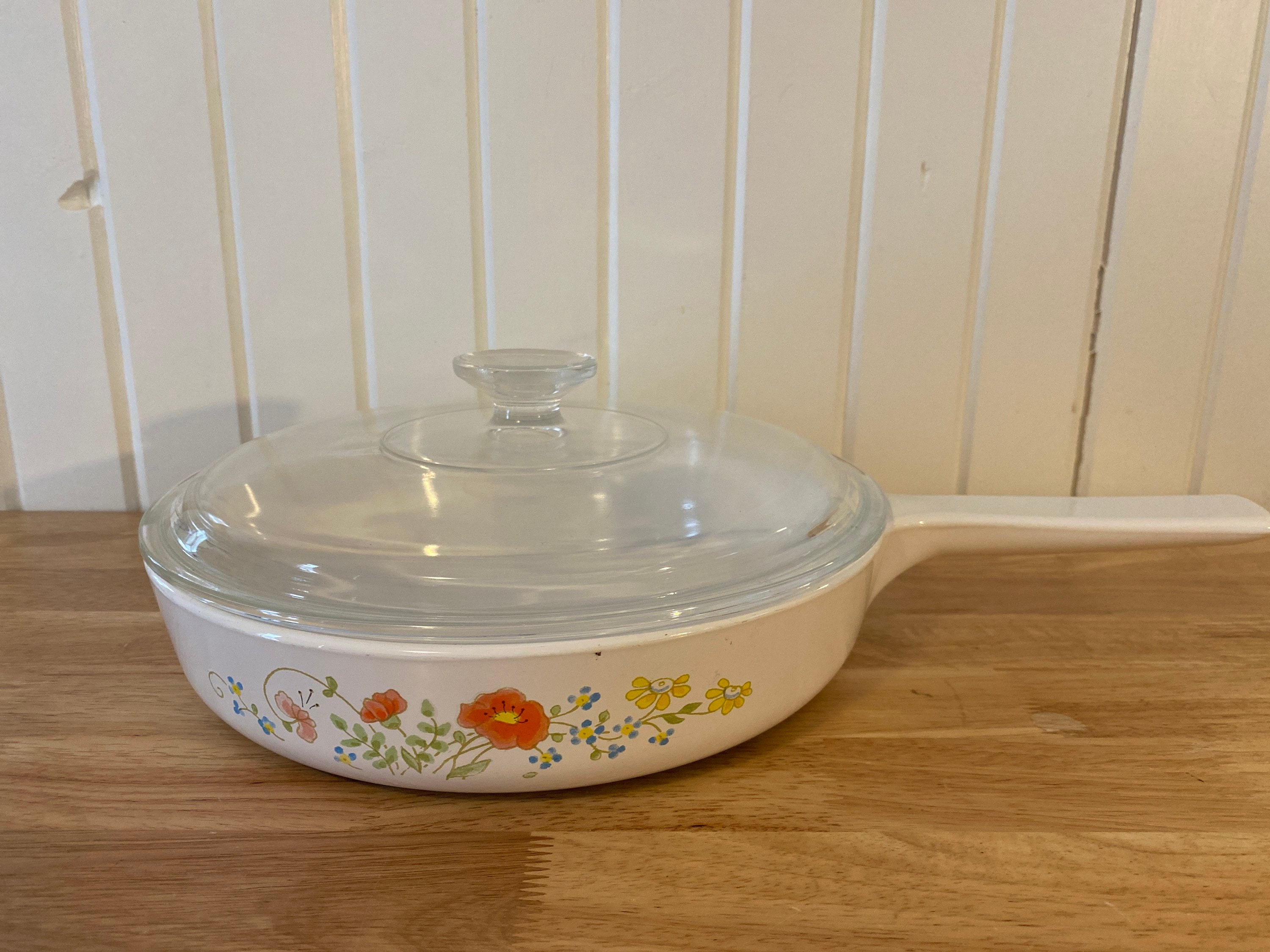
Bright red poppies, yellow daisies, and small blue flowers on a summer-white background. Sometimes confused with Floral Bouquet but visually distinct — bolder, more saturated. A favourite of collectors who want something with colour.
Highly Sought
In stock · $84
☐
Model Directory — Dimensions, Volume, Patterns
The Pieces
A reference index of standard North American models with dimensions, capacity, and pattern availability.
📐 Notes on measurements: Dimensions are interior measurements unless otherwise noted. Weights are approximate and vary by era and production run. Pre-1972 P-series and post-1972 A-series pieces share the same capacity designations but differ in proportions — P-series pieces have sloped sides; A-series have straight sides. Both are noted where relevant.
Saucepans / Casseroles — Square (Primary Line)
A-Series & P-Series
Model (A-series)
P-series Equiv.
Capacity
Interior Dim.
Approx. Weight
Patterns Available
A-1-B
P-1-B
1 qt / 1 L
6¾" × 6¾" × 2"
c. 1.1 lb
Cornflower, Spice O' Life, Wildflower, Floral Bouquet, English Meadow, Shadow Iris, Pastel Bouquet, Abundance, and most major patterns
A-1½-B
P-1½-B
1.5 qt / 1.4 L
7⅞" × 7⅞" × 2"
c. 1.3 lb
Cornflower, Spice O' Life, Wildflower, Floral Bouquet, Pastel Bouquet, and most major patterns
—
P-1¾-B
1.75 qt
8" × 8" × 2"
c. 1.4 lb
Cornflower only (discontinued 1972 — P-series only, no A-series equivalent)
A-2-B
P-2-B
2 qt / 2 L
8¾" × 8¾" × 2"
c. 1.6 lb
Cornflower, Spice O' Life, Wildflower, Floral Bouquet, Country Festival, Pastel Bouquet, most major patterns
A-3-B
P-3-B
3 qt / 2.8 L
10⅜" × 10⅜" × 2⅛"
c. 2.0 lb
Cornflower, Spice O' Life, Country Festival, Wildflower, most major patterns
A-5-B
P-5-B
5 qt / 4.7 L
11¾" × 11¾" × 2⅞"
c. 3.0 lb
Cornflower, Spice O' Life, Country Festival — fewer patterns than smaller sizes
Small & Specialty Pieces
Petites, Grab-Its & Individual Casseroles
Model
Type
Capacity
Dimensions
Notes
P-41-B
Individual Casserole
16 oz / 2 cups
5" × 5" × 1¾"
Often sold in sets of 4. Available in Cornflower, Spice O' Life, Wildflower. The "individual serving" workhorse.
P-43-B
Petite Pan
10 oz / 1¼ cups
4½" × 4½" × 1½"
Smallest standard casserole. Often sold in 4-packs with P-41-B. Many patterns.
A-140 (Grab-It)
Bowl w/ handle
15 oz
6" diameter
Round, single handle. 1980s design. Available in French White and later patterns.
A-1¼-B
Mini Casserole
1.25 qt
c. 7" × 7"
Less common size. Cornflower and Spice O' Life primarily.
Baking Dishes
Roasters & Rectangular Pans
Model
Type
Capacity
Dimensions
Approx. Weight
Notes
P-21 / A-21
Baking Dish
3 qt
9" × 13"
c. 2.5 lb
The standard casserole dish shape. Available in Cornflower; fewer patterns than saucepans.
P-76-B
Large Baking Dish
4 qt
10" × 15"
c. 3.5 lb
Large roasting pan format. Cornflower and white primarily. Lighter than comparable Pyrex.
F-21-B
French White Roaster
4.5 L
c. 10" × 14"
c. 4.3 lb
French White series — different shape from the P/A series rectangular dishes. Heavier than P-series equivalents.
Skillets
Stovetop Cooking Pieces
Model
Size
Type
Notes
P-7-B / A-7-B
7"
Skillet
Early (pre-1972) pieces have fin-style pyroceram lids. Cornflower primary.
P-9-B
9"
Skillet
P-series only. Cornflower. Less common than the 10".
P-10-B / A-10-B
10"
Skillet
The most common skillet size. Available in Cornflower, Spice O' Life, and a few others.
Round. Also available in the holiday/employee edition designs.
B-4
4 qt (Dutch Oven)
Largest standard round piece. Cornflower, Spice O' Life.
Percolators
Coffee Makers
CorningWare percolators are among the most collectible pieces — and among the most fragile to ship. They were produced in both Pyroceram (the stove-safe body) with a separate Pyrex carafe. Many were recalled in the late 1970s over handle concerns, which is why intact examples are genuinely harder to find.
Model
Capacity
Era
Patterns
P-106
6 cup
1959 – c. 1972
Cornflower, Starburst (Black), Platinum Starburst
P-108
8 cup
1959 – c. 1972
Cornflower, Starburst (Black), Platinum Starburst
A-series percolators
Various
1972 – late 1970s
Spice O' Life, Cornflower, Country Festival
Pattern + Model Cross-Reference: Not every pattern was produced in every model. The larger and more popular patterns (Cornflower, Spice O' Life) appear across virtually the entire product range. Shorter-run patterns (Blue Heather, Wildflower, Merry Mushroom) were typically limited to a subset of sizes. When in doubt, the CorningWare411.com consolidated patterns page is the definitive reference.
?
Separating Signal from Noise
Myths & Facts
The internet has done some creative things with CorningWare valuations. Here's a grounded look at what's real.
Every few years, a viral post appears claiming someone found a CorningWare dish worth thousands of dollars at a thrift store. The claims spread. The asking prices on eBay spike. Then the sold listings tell a different story. Here's what collectors actually know.
✗ Myth
"My Blue Cornflower set is worth thousands of dollars."
Blue Cornflower is the most-produced CorningWare pattern in history. Hundreds of millions of pieces were made. You can find them at virtually every thrift store in North America for $3–8 each. A complete set in excellent condition might fetch $40–80 at a garage sale. The occasional viral listing asking $2,500 is asking — it is not selling. Check sold listings, not asking prices. This is true for almost all common patterns.
✓ Fact
Realistic value ceiling for the vast majority of CorningWare is under $100.
For common patterns in standard sizes, $15–50 is the real market range for individual pieces in excellent condition. A 1-quart Cornflower saucepan with original lid and no chips sells for around $20. A 5-piece set in pristine condition, maybe $60. The curator of this guide has never encountered a verified sale of common-pattern CorningWare exceeding $300. For genuinely rare pieces — percolators with the Black Starburst pattern, intact early Renaissance or Platinum Filigree gift line sets — values can climb to $150–300. Beyond that, you are in exceptional territory.
✗ Myth
"CorningWare contains lead and is dangerous to cook with."
The decorated patterns on vintage CorningWare used ceramic or enamel-based pigments that sit on the surface of the Pyroceram. There has been periodic concern about lead in vintage dinnerware broadly. The Pyroceram body itself is inert and non-reactive. The practical guidance from the collector community: if you're concerned, use your vintage pieces for serving rather than stovetop cooking, don't use abrasive cleaners that might degrade the decoration, and don't use pieces with significant chips or crazing on the decorated surface. For storage and reheating purposes, intact vintage CorningWare is widely considered safe.
✗ Myth
"All CorningWare can go from freezer to stovetop."
The Pyroceram body can. The lids cannot. CorningWare lids are Pyrex glass — borosilicate (older) or tempered soda-lime (post-1990s) — neither of which should be subjected to extreme thermal shock. Also: post-2001 stoneware CorningWare is explicitly marked "Not for Stovetop Use." If the bottom of your dish says that, it means it. The rule is simple: check the bottom. If it doesn't say Pyroceram or have the stovetop symbol, treat it as bakeware only.
✓ Fact
The handles on early Cornflower pieces are a reliable dating tool.
Pre-1972 P-series pieces have small, relatively narrow handles and sloped sides. After the transition to the A-series in 1972, the sides became straight and the handles noticeably larger. If you find a Blue Cornflower piece with small handles and sloped sides, it predates 1972 and is genuinely older — and in collector terms, somewhat more interesting than later production.
✗ Myth
"Corning still makes CorningWare in the US."
Pyroceram-based CorningWare has not been manufactured in the United States since the early 2000s, when the Martinsburg, WV plant closed. The Pyroceram product line — reintroduced in 2008 — is manufactured in France by Keraglass (Saint-Gobain). The stoneware CorningWare sold at most North American retailers today is made in Asia. The brand name is the same; the product is entirely different.
✗ Myth
"The Spice O' Life pattern with French writing is extremely rare and worth $1,000+."
Early Spice O' Life pieces did include French herb names (L'Échalote, Marjolaine, etc.) as part of the pattern design. These were phased out in later production runs. The French-inscription versions are genuinely older and somewhat more sought-after, and do command a modest premium — typically $50–150 for a common saucepan in excellent condition. The four-figure prices occasionally seen on eBay listings are asking prices, not sales. A realistic ceiling for an early French-inscription Spice O' Life 1-quart is around $100–150 in excellent condition with lid.
✓ Fact
Percolators are the single highest-value category for most collectors.
Coffee percolators — particularly the Black Starburst / Trefoil and Platinum Starburst models from 1959–1973 — command the highest consistent prices in the CorningWare collector market. Many were recalled in the late 1970s, and those that survived are often found missing parts. An intact 6- or 8-cup percolator with the rare starburst pattern, all parts present, can reasonably fetch $100–200 and occasionally more. They're also difficult to ship without damage, which suppresses online supply.
✗ Myth
"CorningWare is indestructible."
Pyroceram is extraordinarily resistant to thermal shock — but it can and does chip, crack, and break under sufficient impact. Drop a casserole dish on a tile floor from counter height and there's a real chance it doesn't survive. The material is also susceptible to damage from certain cleaning chemicals and from impacts to the corners and edges. "Virtually indestructible" was marketing language. It's a durable glass-ceramic, not an actual miracle of physics.
✓ Fact
Stoneware CorningWare and Pyroceram CorningWare look nearly identical — and are completely different products.
This is possibly the most practically important thing to understand when buying vintage CorningWare. Post-2001 stoneware pieces are heavier, cannot be used on a stovetop, and will crack under thermal shock. The easiest way to distinguish them: look at the bottom. Vintage Pyroceram pieces will say "CORNING WARE" (two words, pre-1998) or "CorningWare" and will have stovetop symbols or a capacity marking. Stoneware pieces typically say "Not for Stovetop Use" explicitly. When in doubt, do not put it on a burner.
✦
The Rarest CorningWare of All
Employee Editions
Each Christmas from approximately 1962 to 1998, Corning gave its plant workers something no one else could buy.
Every year at the end of the last shift before Christmas, Corning Glass Works gave its plant employees a special-edition piece of CorningWare bearing a holiday design. These pieces were never sold in stores. Approximately 2,000 pieces were produced of each annual design — one for each employee. They are the rarest standard CorningWare objects in existence.
The tradition apparently began around 1962 or 1963 and continued until roughly 1998, the year before Pyroceram production effectively ended in the United States. That's approximately 35 distinct holiday patterns across roughly 35 years — a small, extraordinary body of objects that most collectors will never see in person.
What We Know
The Basic Facts
The holiday designs were applied to standard CorningWare piece shapes — typically saucepans in the 1- and 1½-quart sizes, though rounds and open roasters are also documented. The designs themselves were seasonal: Christmas trees, wreaths, poinsettias, snowflakes, and winter motifs that varied year to year.
Because these pieces were gifts to employees rather than retail products, documentation is sparse. No official catalogue of all holiday designs exists in the public record. What we know comes from collector community research — particularly the work of Shane T. Wingerd at CorningWare411.com, who has tracked down images and first-hand accounts from former employees and their descendants.
One particularly well-documented piece is a 1962 teapot with a "Season's Greetings" design, which has surfaced on the secondary market in good condition. A 1965 round saucepan (model P-93-B, a 2½-quart handled round piece) bearing a holiday design has also been documented — a model number that appears nowhere in the standard production records, suggesting it may have been made specifically for the employee program.
Known & Documented Examples
A Partial Record
c. 1962–1963
Program Begins
The first documented holiday employee pieces date to approximately 1962. A teapot with "Season's Greetings" design from this era has been documented in collector archives.
1965
P-93-B: A Mystery Piece
A 2½-quart round handled saucepan (model P-93-B) with a Christmas motif — a model number with no known parallel in standard production records. Evidence that Corning may have produced exclusive shapes for the employee program, not just exclusive patterns.
1969
A Confirmed Year
Holiday pieces from 1969 have been documented. Likely produced in the butterscotch and standard white colourways given what was in production that year.
1987
A Specific Date Known
At least one piece from 1987 is documented — confirmed through the collector community, though images are rarely seen publicly.
1996
Christmas Tree Design
A Christmas tree pattern from approximately 1996 is documented and associated with a matching Italian dinnerware design (Furio Home brand). One of the more recently identified holiday pieces.
c. 1998
Program Ends
As Corning sold its consumer products division and plants began closing, the holiday gift tradition ended. The last documented employee editions appear to be from around 1998.
Buying & Finding
How to Look
Employee holiday pieces very occasionally surface on eBay and Etsy, typically through estate sales of former plant employees or their families. The Corning, NY area (where the main plants were) and the Pittsburgh, PA region (Charleroi plant) are the most likely geographic sources.
Because so little documentation exists, provenance matters more than usual here. A seller who can describe where the piece came from — "my grandfather worked at the Corning plant" — is meaningfully more credible than a listing with no context. The design itself should look like deliberate holiday imagery applied to standard Pyroceram, not a crude aftermarket decoration.
Values are genuinely hard to establish — the market is thin and most transactions are private or poorly documented. Given that only ~2,000 of any single design were ever made, and that most were used and discarded, surviving pieces in excellent condition are probably worth $100–300 to the right collector. What they aren't: investment pieces. They're historical artefacts of a mid-century American manufacturing tradition that no longer exists.
If you have one: If you inherited or found what appears to be an employee edition piece, the collector community at CorningWare411.com is the best resource for identification. Shane Wingerd has documented more of these pieces than anyone else and is generally responsive to inquiries with good photographs and provenance information.
📺
CorningWare on Screen
In Culture
Decades of background presence in the American kitchen — and occasionally the foreground.
CorningWare didn't get product placement deals. It didn't need them. It was simply present — on countertops, in refrigerators, on stovetops — in almost every American and Canadian kitchen from the early 1960s onward. When TV and film set designers needed to dress a kitchen authentically, CorningWare was the shorthand for "a real family lives here."
The Blue Cornflower pattern in particular became a semiotic marker: it communicates domesticity, middle-class practicality, a certain postwar hopefulness. Period productions set from the 1960s through the 1990s often include it deliberately, as a signifier of authenticity.
On Screen
Known & Documented Appearances
1960s–1970s
The Brady Bunch (1969–1974)
The Brady kitchen was one of the most-watched domestic spaces in American television. Blue Cornflower CorningWare appears in multiple background kitchen scenes — a natural choice for set dressers filling out a realistically appointed middle-class American kitchen of the era.
1960s
Bewitched (1964–1972)
Samantha Stephens' kitchen was a showcase of mid-60s domestic modernity. CorningWare's stovetop-to-oven versatility fit perfectly with the show's vision of a supernaturally well-run household. Blue Cornflower appears in kitchen scenes across multiple seasons.
1970s
All in the Family (1971–1979)
The Bunker household kitchen was dressed with period-accurate working-class American domesticity. CorningWare on the stovetop was exactly the kind of detail the show's production team used to ground the Archie and Edith scenes in recognizable reality.
1970s
The Mary Tyler Moore Show (1970–1977)
Mary Richards' apartment kitchen — the kitchen of the independent working woman — regularly featured CorningWare. The show's production design was unusually precise about period-accurate consumer goods, and CorningWare was a natural fit for a kitchen used by someone who cooked but didn't centre her life around it.
2000s (set in 1960s)
Mad Men (2007–2015)
Mad Men's production team was famously rigorous about period accuracy — researchers verified weather conditions, news events, and product availability for each episode. Blue Cornflower CorningWare appears in Betty Draper's kitchen as exactly the kind of detail that grounds the domestic scenes of the early 1960s. It was introduced in 1958, just before the show's starting point.
1980s (set in 1980–82)
The Goldbergs (2013–2023)
The Goldbergs' kitchen was painstakingly dressed with period-accurate 1980s domestic goods. CorningWare — by the 1980s firmly part of every middle-class American kitchen — appears regularly in the Beverly Goldberg cooking scenes. The show's attention to period detail made it a reference point for what was actually in people's homes.
1990s (various)
Roseanne (1988–1997)
The Connor household kitchen was one of the most deliberately unglamorous domestic spaces in network television — which made it one of the most authentic. CorningWare appears throughout the series as part of a kitchen that looks genuinely used by a family that actually cooks.
Various
Period Films: American Settings
Any film set in an American domestic interior between roughly 1960 and 1995 has a reasonable chance of featuring CorningWare in kitchen scenes. Production designers use it as a reliable visual anchor for middle-class authenticity — recognizable to audiences, period-correct, and actually available through prop houses that stock vintage kitchen goods.
A Note on Research
Help Document This
Screen appearances of CorningWare are poorly documented in any centralised way. The collector community has noted individual examples, but no comprehensive catalogue exists. If you spot a confirmed appearance — episode, timestamp, pattern visible — this guide would welcome the addition.
The best approach: look at the kitchen scenes. Look at what's on the stovetop or counter while characters talk. The Blue Cornflower pattern is visually distinctive even in the background of a shot. The white body with three blue flowers is hard to miss once you're looking for it.
◈
Print Advertising 1958–2001
Vintage Advertising
How Corning sold the idea of the stovetop-to-table kitchen — across four decades of changing American domestic life.
🖼 Curator's note on this gallery: Vintage CorningWare print ads are widely available through image search, but reproducing them here raises copyright questions. Each frame below identifies the era, the likely visual approach, and a suggested search query to find the original. This is an image-ready gallery — drop your own found ads into the frames or link to archive sources. Good starting points: eBay completed listings (search "CorningWare advertisement vintage"), Flickr vintage ads pools, Archive.org scanned magazine archives, and WorthPoint's price guide images.
◻
Late 1950s — Launch Era
The Introduction
The first CorningWare ads emphasized the miracle of the material — from freezer to stove, one dish. Scientific language. Diagrams. The promise of modernity.
Search: "CorningWare 1958 1959 advertisement"
◻
Early 1960s
The Happy Housewife
Smiling women, immaculate kitchens, husband returning home to a table already set. The Blue Cornflower at centre frame. Copy heavy on versatility and convenience.
Search: "CorningWare 1960s vintage ad cornflower"
◻
Mid-1960s
The Gift
CorningWare positioned as the ideal wedding gift — practical and beautiful. Gift box imagery. Copy often emphasized that one set could last a lifetime.
Search: "CorningWare gift wedding advertisement 1965"
◻
Late 1960s
The Percolator Era
Ads featuring the stovetop percolator alongside the casserole set — positioning CorningWare as a complete kitchen system. Starburst and Cornflower patterns both visible.
The introduction of the second major pattern. French-inflected copy. The herbs and vegetables motif positioned as sophisticated — a nod to the Julia Child era of American cooking interest.
Search: "CorningWare Spice Life 1972 advertisement"
◻
Mid-1970s
Country Festival & Wildflower
The bold, colourful 70s patterns in full-page magazine spreads. Earth tones, lifestyle photography, the new informality of the American table. Often appearing in women's magazines like Better Homes & Gardens.
Search: "CorningWare Country Festival 1975 ad"
◻
Late 1970s
French White Introduction
The 1978 launch of French White brought a more contemporary, minimalist visual language to the advertising — white on white, elegant table settings, the shift toward the 1980s aesthetic.
Search: "CorningWare French White 1978 advertisement"
◻
1980s
The Microwave Age
CorningWare ads begin prominently featuring the microwave oven — a new kitchen appliance that CorningWare's Pyroceram was perfectly suited for. "From freezer to microwave to table" replaced the earlier stovetop emphasis.
Softer imagery, warmer tones, the pastel palette of the late 80s–early 90s. CorningWare advertising had become less about the material's miracle properties and more about lifestyle and pattern selection.
Search: "CorningWare English Meadow advertisement"
◻
Late 1990s
The Final Pyroceram Years
Advertising became sparse as Corning wound down the consumer division. The brand had moved from scientific wonder to kitchen staple — so familiar it barely needed advertising anymore. A quiet end to the original era.
Search: "CorningWare 1990s late advertisement catalog"
◻
Various Decades
Canadian Market Ads
Canadian advertising followed American campaigns closely but occasionally featured different patterns or French-language versions for the Quebec market. Chatelaine and Canadian Living ran CorningWare ads across multiple decades.
Search: "CorningWare Canadian advertisement Chatelaine vintage"
◻
Various
Television Commercials
CorningWare ran television commercials through the 1960s and 70s. A handful survive on YouTube — search "CorningWare commercial 1960s" or "CorningWare ad vintage TV" for broadcast-era footage of the product in motion.
The best sources for vintage CorningWare advertising imagery, in order of reliability and legality:
Archive.org — Scanned issues of Better Homes & Gardens, Ladies' Home Journal, and other major magazines from 1958 onward. Search within specific decades for CorningWare. Free and publicly accessible.
eBay (completed listings) — Vintage magazine pages with CorningWare ads are regularly listed. Search "CorningWare advertisement" with the "Sold" filter active to see what's actually traded. You can buy original print ads for a few dollars.
Flickr vintage ads groups — Several Flickr pools aggregate vintage kitchen and housewares advertising. Search "CorningWare" within the "Classic Ads" and "Vintage Advertisements" groups.
WorthPoint — The collector-focused pricing database includes extensive image archives for CorningWare. A subscription is required but the imagery is comprehensive.
YouTube — Search "CorningWare vintage commercial" for surviving television spots from the 1960s and 70s. A small number have been digitized and uploaded by collectors.
✿
About This Guide
The Curator
Who made this, and why CorningWare.
This section is written by the curator. The content below is a placeholder — replace with your own words.
[ Your personal narrative goes here — your mother's kitchen, the weekly dinners, what CorningWare meant in your household, and what brought you to building this guide. ]
About This Guide
Sources & Acknowledgements
This guide is unofficial, independent, and non-commercial. It is not affiliated with Corning Inc., Instant Brands, or any current trademark holder of the CorningWare name.
The primary research source for production dates, model numbers, and pattern history is CorningWare411.com, maintained by Shane T. Wingerd — an extraordinary public resource built over many years by a dedicated collector and researcher. If you want to go deeper on any aspect of CorningWare history, that is the place to start.
Additional sources include collector community discussions on eBay, Reddit (r/vintagekitchenware), and various antique and estate sale forums. Pricing data is drawn from verified sold listings, not asking prices.
CORNINGWARE® is a registered trademark of Corning Incorporated. All pattern names and model numbers referenced here belong to their respective trademark holders. This guide is published for educational and collecting purposes only.